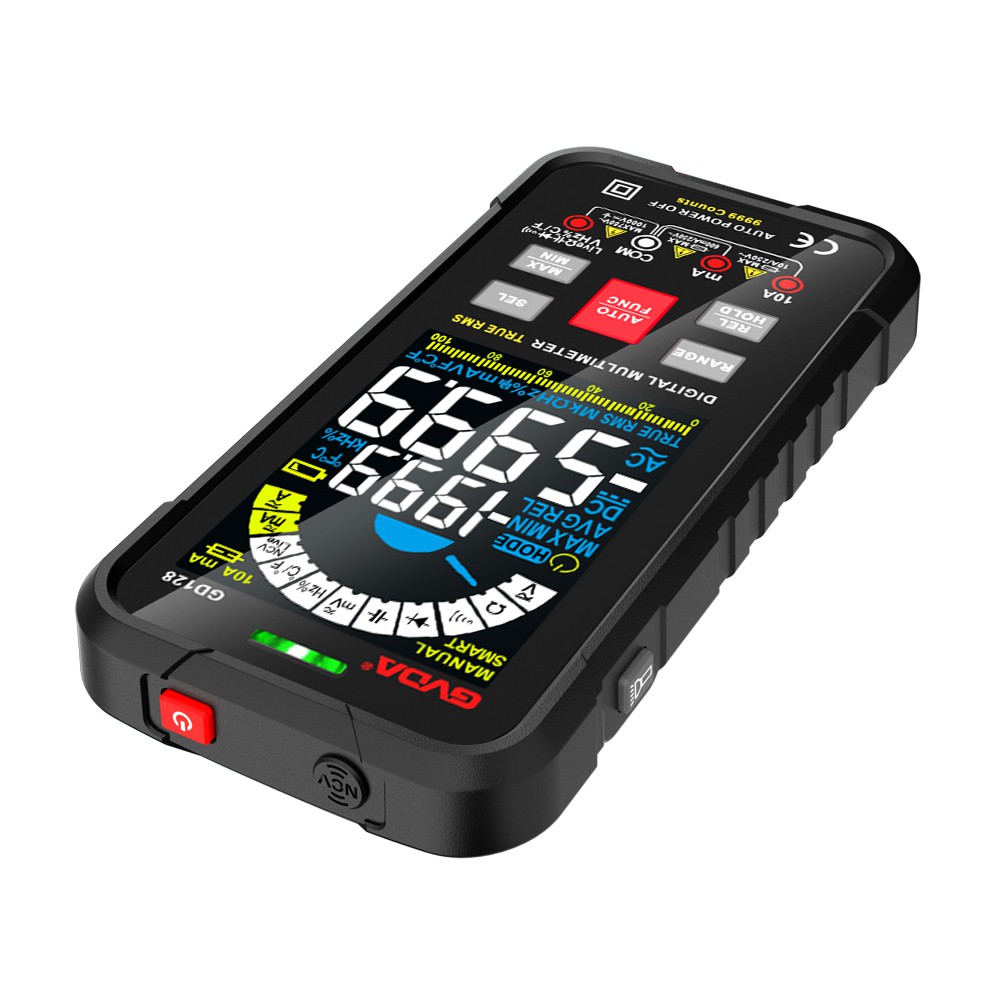
What is a multimeter's actual purpose in measuring resistance?
1. Coils: 1. Two test leads, measuring the two ends of the coil, the function is to judge whether the coil is disconnected. The buzzer will sound when it is on, but it will not sound when it is not.
One test lead is at one end of the coil, the other test lead is broken at the ground wire, measure the resistance value of the coil to the ground, and judge whether the coil insulation layer is burnt out.
Contacts, such as contactors, main contacts and auxiliary contacts of intermediate relays. Put the test leads at both ends, measure whether the contact is good, and judge whether the contactor should be replaced.
Diodes/Transistors. Measure its resistance, the diode has unidirectional conductivity, you can judge the positive and negative poles of the diode, and you can also judge whether the diode is good or bad, and whether it is reversely broken down.
Another function of the multimeter's electrical barrier is to measure the conduction voltage of the diode. Select the gear to electric blocking, and switch it to measure the conduction voltage of the diode. The silicon tube is 0.7V, and the germanium tube is 0.3V. To judge whether the quality of the diode is good or bad.
Note that when measuring resistance with a multimeter, the machine must not be charged. Power off to measure resistance.
The above is just the usage and function of multimeter electric barrier.
The more commonly used is the voltage block.
Use the voltage block of the multimeter, put one test lead on the place you want to measure, and the other test lead on the reference point, usually the ground wire or the metal case, and measure whether the voltage meets the requirements of our design. There is 220V between the live wire and the ground wire, and 220V between the live wire and the neutral wire. The voltage between live wire and live wire is 380V. Satisfying these three numbers means that the incoming line is normal.
The ohm gear of the multimeter is the most used gear
When we are repairing or checking circuits and components, we usually use ohm files. To sum up, the commonly used functions and uses are as follows:
1. Measure the continuity of the circuit, such as the measurement of the motor coil. In this case, many of them also use the buzzer to measure
2. Measure the resistance of each circuit and component to calculate its power and other parameters. For example, our electric furnace can calculate its heating power according to the measured resistance.
3. It is used to judge whether the component is good or bad. For example, for a chip or component, the normal resistance between a certain two pins is 100 ohms, but the actual resistance is 1K, or infinite. The component must be broken, such as a thermistor. Measure the resistance at both ends, if it does not change with temperature, then the thermistor should be broken
4. Measure the actual resistance value of the resistors in the circuit. Some color ring resistors cannot be seen clearly, and the actual resistance value of the color ring resistors is also verified!