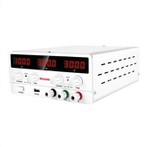
What is a switching regulated power supply? What are the characteristics?
A linear regulated power supply refers to a regulated power supply in which the regulator tube works in a linear state. But it is different in the switching power supply. The switching tube (in the switching power supply, we generally call the adjusting tube a switching tube) works in two states of on and off: on - the resistance is very small; off - the resistance is very small big.
Switching power supply is a relatively new type of power supply. It has the advantages of high efficiency, light weight, step-up and step-down, and large output power. However, since the circuit works in the switching state, the noise is relatively large. Through the figure below, let's briefly talk about the working principle of the step-down switching power supply. As shown in the figure, the circuit is composed of switch K (transistor or field effect transistor in the actual circuit), freewheeling diode D, energy storage inductor L, filter capacitor C, etc. When the switch is closed, the power supply supplies power to the load through the switch K and the inductor L, and stores part of the electric energy in the inductor L and the capacitor C. Due to the self-inductance of the inductance L, after the switch is turned on, the current increases slowly, that is, the output cannot reach the power supply voltage value immediately. After a certain period of time, the switch is turned off, and due to the self-inductance of the inductor L (it can be compared visually that the current in the inductor has an inertial effect), the current in the circuit will remain unchanged, that is, continue to flow from left to right. This current flows through the load, returns from the ground wire, flows to the anode of the freewheeling diode D, passes through the diode D, and returns to the left end of the inductor L, thus forming a loop. By controlling when the switch closes and opens (ie PWM - Pulse Width Modulation), the output voltage can be controlled. If the on and off time is controlled by detecting the output voltage to keep the output voltage constant, the purpose of voltage regulation is achieved.
When the switch is closed, the inductor stores energy; when the switch is turned off, the inductor releases energy, so the inductor L is called an energy storage inductance. The diode D is responsible for providing a current path to the inductor L when the switch is turned off, so the diode D is called a freewheeling diode.
In the actual switching power supply, the switch K is replaced by a triode or a field effect tube. When the switch is turned off, the current is very small; when the switch is closed, the voltage is very small, so the heating power U×I will be very small. This is why switching power supplies are highly efficient.