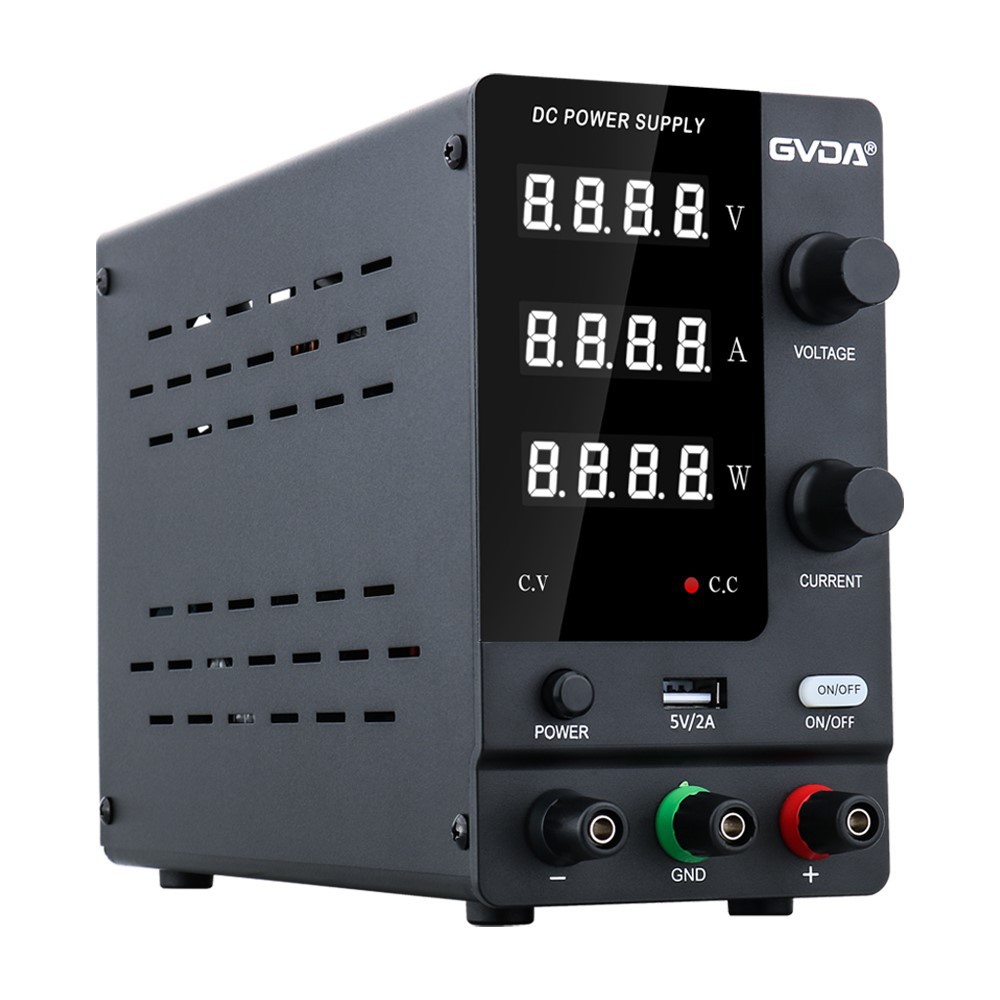
What is the difference between switching power supply and ordinary linear power supply?
The ordinary power supply is generally a linear power supply, and the linear power supply refers to the power supply in which the regulating tube works in a linear state. But it is different in the switching power supply. The switching tube (in the switching power supply, we generally call the adjusting tube as the switching tube) works in two states of on and off: on - the resistance is very small, off - the resistance is very high Big.
Switching power supply is a relatively new type of power supply. It has the advantages of high efficiency, light weight, step-up and step-down, and large output power. However, since the circuit works in the switching state, the noise is relatively large.
Let's briefly talk about the working principle of the step-down switching power supply: the circuit is composed of a switch (transistor or field effect tube in the actual circuit), a freewheeling diode, an energy storage inductor, and a filter capacitor.
When the switch is closed, the power supply supplies power to the load through the switch and the inductor, and stores part of the electric energy in the inductor and capacitor. Due to the self-inductance of the inductance, after the switch is turned on, the current increases slowly, that is, the output cannot reach the power supply voltage value immediately.
After a certain period of time, the switch is turned off, and due to the self-inductance of the inductor (it can be compared visually that the current in the inductor has an inertial effect), the current in the circuit will remain unchanged, that is, continue to flow from left to right. This current flows through the load, returns from the ground wire, flows to the anode of the freewheeling diode, passes through the diode, and returns to the left end of the inductor, thus forming a loop.
By controlling when the switch closes and opens (ie PWM - Pulse Width Modulation), the output voltage can be controlled. If the on and off time is controlled by detecting the output voltage to keep the output voltage constant, the purpose of voltage regulation is achieved.
The common power supply and the switching power supply have the same voltage adjustment tube, which uses the feedback principle to stabilize the voltage. The difference is that the switching power supply uses the switching tube to adjust, and the ordinary power supply generally uses the linear amplification area of the triode to adjust. In comparison, the switching power supply has low energy consumption, a wide range of application to AC voltage, and a better ripple coefficient of output DC. The disadvantage is switching pulse interference.
The main working principle of the ordinary half-bridge switching power supply is that the switching tubes of the upper bridge and the lower bridge (when the frequency is high, the switching tube is VMOS) are turned on in turn. First, the current flows in through the switching tube of the upper bridge. In the coil, the switch tube of the upper bridge is finally turned off, and the switch tube of the lower bridge is turned on, and the inductance coil and the capacitor continue to supply power to the outside. Then turn off the switch tube of the lower bridge, and then open the upper bridge to let the current enter, and repeat like this, because the two switch tubes need to be turned on and off in turn, so it is called a switching power supply.
The linear power supply is different. Since there is no switch involved, the upper water pipe is always discharging water. If there is too much water, it will leak out. This is what we often see in some linear power supply adjustment tubes. The endless electrical energy is all converted into heat energy. From this point of view, the conversion efficiency of the linear power supply is very low, and when the heat is high, the life of the components is bound to decrease, affecting the final use effect.
The power adjustment tube of the linear power supply always works in the amplification area, and the current flowing through it is continuous. Due to the large power loss on the adjustment tube, a large power adjustment tube is required and a large radiator is installed, the heat is serious, and the efficiency is very low, generally 40%~60% (it has to be said that it is very linear) power supply).
The working method of the linear power supply makes it necessary to have a voltage device to change from high voltage to low voltage. Generally, it is a transformer, and there are others like KX power supply, which then rectifies and outputs DC voltage. In this way, the volume is large, cumbersome, low efficiency, and high heat generation; but it also has advantages: small ripple, good adjustment rate, small external interference, suitable for use with analog circuits/various amplifiers, etc.
The power device of the switching power supply works in the switching state. When the voltage is adjusted, the energy is temporarily stored through the inductance coil, so that its loss is small, the efficiency is high, and the requirement for heat dissipation is low, but it has low requirements for transformers and energy storage inductors. There are also higher requirements, and it is necessary to use materials with low loss and high magnetic permeability. Its transformer is the size of a word. The total efficiency is 80% to 98%. The switching power supply has high efficiency but small size, but compared with the linear power supply, its ripple and voltage and current adjustment rate have a certain discount.