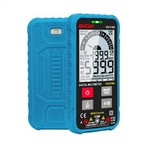
What is the measurement principle of the lux meter?
An illuminance meter (or lux meter) is an instrument designed to measure illuminance.
It is to measure the degree of illumination of the object, that is, the ratio of the luminous flux obtained on the surface of the object to the illuminated area.
The illuminance meter is usually composed of a selenium photocell or a silicon photocell with a filter and a microammeter.
Photovoltaic cells are photoelectric components that directly convert light energy into electrical energy.
When light hits the surface of the selenium photovoltaic cell, the incident light passes through the metal thin film 4 and reaches the interface between the semiconductor selenium layer 2 and the metal thin film 4, generating a photoelectric effect on the interface.
The magnitude of the generated photocurrent has a certain proportional relationship with the illuminance on the light-receiving surface of the photocell.
6 At this time, if an external circuit is connected, a current will flow, and the current value will be indicated on the microampere meter with lux (Lx) as the scale.
The magnitude of the photocurrent depends on the intensity of the incident light. The illuminance meter has a shifting device, so it can measure high illuminance and low illuminance.
Types of illuminance meters:
1. Visual illuminance meter: inconvenient to use, low precision, rarely used
2. Photoelectric illuminance meter: commonly used selenium photocell illuminance meter and silicon photocell illuminance meter