Using a clamp ammeter to check for low voltage line leakage and theft
The correct use of digital display test pens should master the following contents:
(1) Button Description:
(A key) DIRECT, directly measure the button (far from the LCD screen), that is, when using the pen to directly contact the circuit, please press this button.
(B key) INDUCTANCE, induction measurement button (close to the LCD screen), that is, when using the pen to sense contact with the circuit, please press this button.
Note: No matter how the pen is printed, please remember that the one far away from the LCD screen is for direct measurement; The one closest to the liquid crystal is the sensing key.
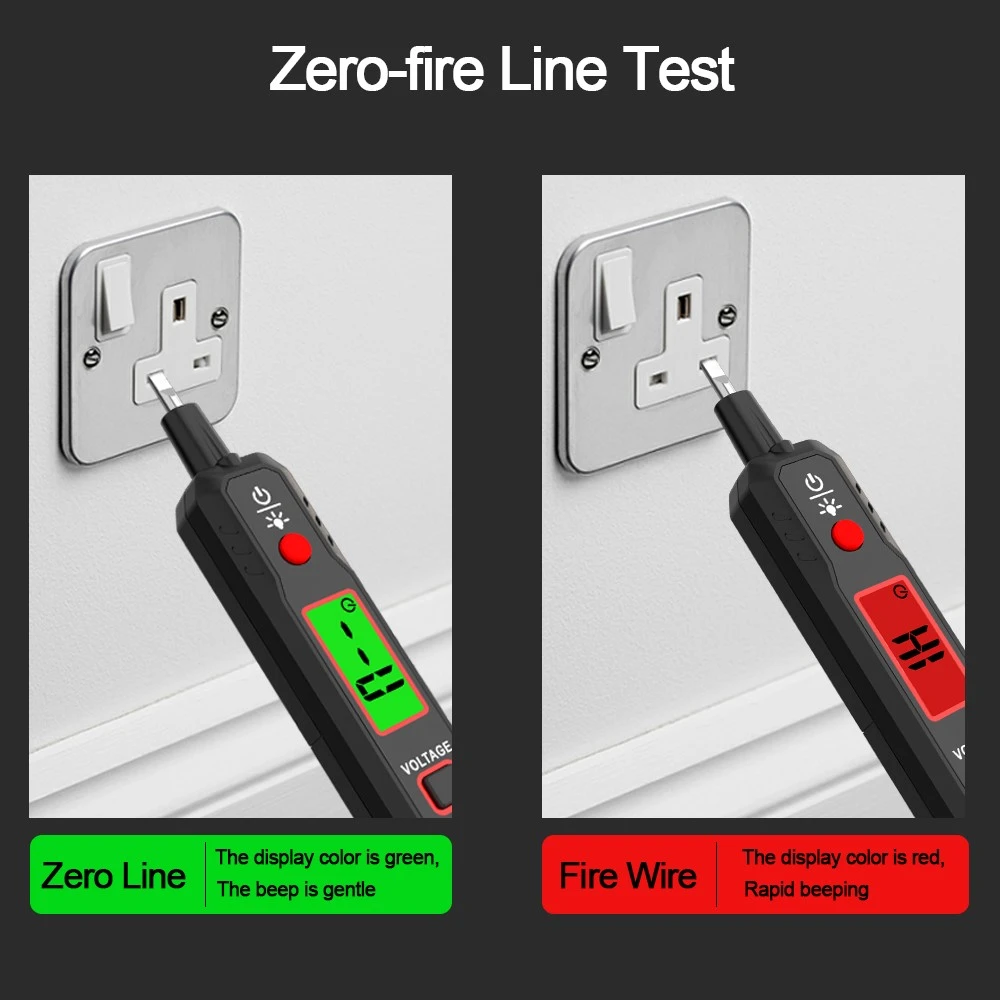
(2) The digital display test pen is suitable for direct detection of AC and DC currents ranging from 12 to 250 V, as well as indirect detection of AC zero lines, phase lines, and breakpoints. It can also measure the on/off of uncharged conductors.
(3) Direct detection:
① The last number is the measured voltage value.
② When the high break display value is not 70%, the low break value is displayed.
③ When measuring direct current, touch the other pole with your hand.
(4) Indirect detection: Hold down the B key and place the pen tip close to the power cord. If the power cord is live, the high voltage symbol will be displayed on the display of the digital display pen.
(5) Breakpoint detection: Press and hold the B key, and when moving longitudinally along the wire, the breakpoint is located where there is no display in the display window.
Why does the zero line of the measuring pen not emit light
Not only is there current passing through, but it is also equal in magnitude to the current in the live wire, because the zero wire is connected in series with the live wire and the consumer, and the current in the series circuit is equal everywhere. Don't believe it, just use an ammeter to measure it. As for why it cannot be measured with a measuring pen, it is simple because the measuring pen is used to distinguish between the live wire and the zero wire, or to determine whether a conductor is connected to the live wire, and cannot determine whether there is current. When the metal body of the stylus tip contacts the live wire or a conductor connected to the live wire, a circuit is formed from the live wire through the stylus, the human body, and the ground. Because there is a 220V voltage between the live wire and the ground, a weak current flows from the live wire through the stylus and the human body to the ground. The neon tube of the stylus emits light, but it is not the same as the current in the live wire. When the metal body of the stylus tip contacts the zero line, there is no voltage between the zero line and the ground, so no current flows through the stylus, and the neon tube of the stylus does not emit light.