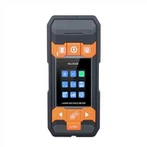
Measure the zero wire of 5 wires in the junction box of the electric pen and multimeter
Two of the wires were wrapped in adhesive tape, namely red wire green adhesive tape and green wire yellow adhesive tape. The water electrician marked the wires when threading them, and these two wires definitely represent a certain meaning. Below, I will use a measuring pen and a multimeter to distinguish their fire zero wires
Electric pen detection method: use an electric pen to test 5 wires separately and find the live wire (usually red is the live wire). For example, if the E red wire is the live wire, connect the two DE wires to the socket and use a desk lamp or charger (mobile phone or other) to insert them. If the fault is missed, it means that the other wire is the ground wire, and if the fault is not tripped, it means that it is correct. If the C line comes from the same pipeline as the DE line, it must be the ground wire. Then, connect the AB lines to the socket and observe if the circuit breaker trips. Can solve the problem
The method of detecting wires with a multimeter is because the live wire is 220V from zero to ground. First, identify the three wires and set the multimeter to an AC voltage range of 200V, as shown in the figure. Wrap the probe in your hand for a few turns, and the other one contacts the wire. The high voltage is the live wire, the low voltage is the zero wire, and the no voltage is the ground wire. After confirming the three wires, measure the voltage of the two wires and the live wire separately. If not, insert them separately.
Alternative usage methods for measuring electric pens
(1) It can be used for low-voltage nuclear phase measurement to determine whether any wires in the circuit are in phase or out of phase. The specific method is to stand on an object that is insulated from the ground, hold a measuring pen with both hands, and then test on the two wires to be tested. If the two measuring pens emit very bright light, the two wires are out of phase; On the contrary, it is in phase, which is judged based on the principle that the voltage difference between the two electrodes of the neon bubble in the measuring pen is directly proportional to its luminous intensity.
(2) It can be used to distinguish between alternating current and direct current. When using a test pen for testing, if both poles in the neon bubble of the test pen emit light, it is an alternating current; If only one of the two poles emits light, it is direct current.
(3) It can determine the positive and negative terminals of direct current. Connect the test pen to a DC circuit for testing, and the electrode with the neon bubble shining is the negative electrode, while the electrode without the neon bubble shining is the positive electrode.
(4) It can be used to determine whether the DC is grounded. In a DC system with insulation to ground, standing on the ground can be used to contact the positive or negative poles of the DC system with a measuring pen. If the neon bubble of the measuring pen is not lit, there is no grounding phenomenon. If the neon bubble lights up, it indicates grounding. If it lights up at the tip of the pen, it indicates positive grounding. If it shines on the finger end, it is negative grounding. However, it must be pointed out that in DC systems with grounding monitoring relays, this method cannot be used to determine whether the DC system is grounded