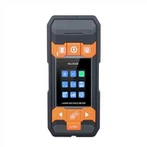
What is the principle of current measurement of MF47 pointer multimeter
MF47-type pointer multimeter, because of the simple structure, compact shape, more features, and soon replaced the then dominant MF500-type multimeter. Now, the world of digital multimeter, but the choice of MF47 type multimeter or small people in.
The core component of the pointer multimeter is the head. The head is a range of 50 microamps of high sensitivity DC ammeter. Whether it is measuring current, voltage, resistance or any other parameter, it is through the peripheral circuitry, the measurement is converted into a power signal that can make the meter head flow through the 0 ~ 50 microamps, in the meter head to mark the corresponding value to read the measured value.
The peripheral circuit not only has the transformation function, but also must have the protection function. But the protection function is not enough and not good enough. In order to protect the core component meter head, the first sacrifice is the peripheral circuit itself. Usually it is the precision resistor that burns out. Do-it-yourself friends, you can replace the resistor according to the original resistance value, the multimeter can be used again!
MF47-type pointer multimeter, is a piece of sensitivity DC20KΩ / V, AC9KΩ / V measurement instrument.
MF47 pointer multimeter is a DC current can be measured ① 0 ~ 0.05mA ~ 0.5mA ~ 5mA ~ 50mA ~ 500mA plus an extension DCA5A or 10A.
② MF47 its DC DCV 0 ~ 0.25V ~ 1V ~ 2.5V ~ 10V ~ 50V ~ 250V ~ 500V ~ 1000V, in addition to adding two series buck 6.75MΩ resistor, DC voltage can be measured 2500V.
③ MF47 AC voltage file has 10V~50V~250V~500V~1000V, extend 2500V and DC voltage common two 6.75MΩ resistors.
④ MF47 its DC resistance block R × 1Ω, R × 10Ω, Rx100Ω, R × 1KΩ, Rx10KΩ. Here is a brief description of the MF47 multimeter voltage at full scale on both sides of how much? Careful users have found in the lower right corner of the multimeter, are marked with a parameter (DC20KΩ/V), there is a full scale of this table, flowing through the ammeter head of the working current of 46.2 uA. According to Ohm's law I = U/R can be calculated, this head of the rated operating voltage of U = I × R = 0.0000462 × 20kΩ = 0.924V rated voltage.
That is to say, when measuring current, the larger the stop, the smaller the resistance of the shunt resistor is bound to be, to ensure that the maximum current through the shunt resistor, the shunt resistor on both sides of the maximum voltage drop does not exceed the rated input voltage of the head 0.924V to do. I have marked the two directions of measuring DC current in the above diagram, as for the questioner said, using a multimeter to measure the short-circuit current of the battery, the fuse burned out, after replacement, the current gear still can not measure the current. Here is a point of clarification, I do not know how much you measured with the DCA file, you can judge which parallel to the DC current file on the resistor has burned out one. I can only use the method of elimination to explain. DC10 gear is a 0.075Ω high-power resistor, it does not participate in the measurement, so it can not be damaged. Then the 500mA gear corresponding to the shunt resistance of 0.456Ω, 50mA gear corresponding to the shunt resistance of 4.56Ω, 5mA gear corresponding to the resistance of 45.6Ω, the last 0.05mA corresponding to the resistance of 456Ω. you can open the back cover of the multimeter, will be more than one knob dialled to the DC current gear to come up to the careful use of the digital multimeter to detect these shunt resistors, generally to you! At that time, the measurement of the dialled gear has a relationship, to ensure that you a check an accurate.