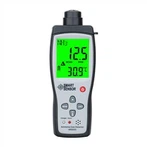
How does a sound level meter work?
A sound level meter is a basic noise measuring instrument. It is an electronic instrument, but it is different from objective electronic instruments such as voltmeters.
When converting acoustic signals into electrical signals, it can simulate the time characteristics of the human ear's response speed to sound waves;
The frequency characteristics of different sensitivities to high and low frequencies and the intensity characteristics of changing frequency characteristics at different loudness. Therefore, a sound level meter is a subjective electronic instrument.
The working principle of the sound level meter is:
The microphone converts the sound into an electrical signal, and the preamplifier then converts the impedance to match the microphone with the attenuator. The amplifier adds the output signal to the weighting network to perform frequency weighting on the signal (or external filter);
Then the signal is amplified to a certain amplitude by the attenuator and amplifier, and then sent to the RMS detector (or an external press level recorder), and the value of the noise level is given on the indicator.
1) A microphone is a device that converts a sound pressure signal into a voltage signal. It is also called a microphone. It is the sensor of the sound level meter. Common microphones are crystal, electret, dynamic and condenser.
A dynamic microphone consists of a diaphragm, a moving coil, a permanent magnet and a transformer.
The diaphragm starts to vibrate after being subjected to sound wave pressure, and drives the movable coil installed with it to vibrate in the magnetic field to generate an induced current.
The current varies according to the magnitude of the acoustic pressure on the vibrating diaphragm. The greater the sound pressure, the greater the current generated, and the lower the sound pressure, the smaller the current generated.
Condenser microphones are mainly composed of metal diaphragms and metal electrodes close together, essentially a flat capacitor.
The metal diaphragm and the metal electrodes constitute the two plates of the flat capacitor. When the diaphragm is subjected to sound pressure, the diaphragm will deform, causing the distance between the two plates to change;
In addition to the capacitance, the voltage in the position measurement circuit is also changed, realizing the effect of converting the sound pressure signal into a voltage signal.
Condenser microphones are ideal microphones in acoustic measurements. It has the advantages of large dynamic range, flat frequency response, high sensitivity, and good stability in general measurement environments, so it is widely used.
Since the output impedance of the condenser microphone is high, impedance conversion is required by the preamplifier, which is installed inside the sound level meter near the part where the condenser microphone is installed.
2) Amplifier
Generally, two-stage amplifiers are used, namely input amplifier and output amplifier, and its function is to amplify weak electrical signals.
The input attenuator and output attenuator are used to change the attenuation of the input signal and the attenuation of the output signal, so that the pointer of the meter head is in the proper position.
The adjustment range of the attenuator used by the input amplifier is the low end of the measurement, and the adjustment range of the attenuator used by the output amplifier is very suitable for the measurement.
Many sound level meters have a 70dB limit on both the gao end and the low end.
3) Weighted network
In order to simulate the different sensitivities of the human ear at different frequencies, there is a network in the sound level meter that can simulate the auditory characteristics of the human ear and correct the electrical signal to an approximate value of hearing. This network is called a weighting network.
The sound pressure level measured by the weighting network is no longer the sound pressure level of the objective physical quantity (called the linear sound pressure level), but the sound pressure level after hearing correction, which is called the weighted sound level or the noise level.