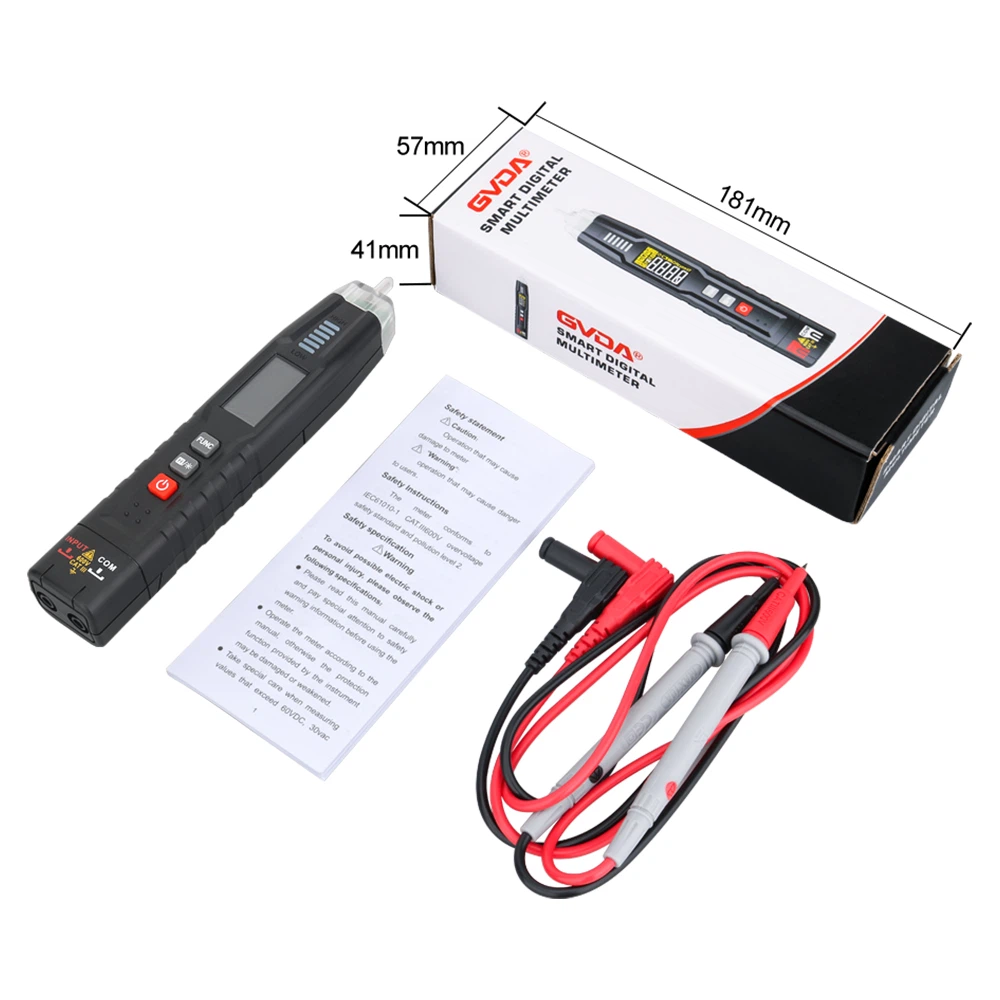
Which one is better, analog multimeter or digital multimeter?
1. Each display method has its own advantages: What is the first reaction of many people when they see a digital multimeter? You will definitely think, wow, this multimeter is so good. It can directly display the measurement in numbers without me having to read it. How convenient! Well, this sentence was heard by the electrician who likes to use analog multimeters, and he retorted. The biggest advantage of an analog watch is its pointer swing, which can very intuitively show the changes in properties of the object being measured, and is more convenient than a digital watch.
From the above point of view, it can be said that they are almost the same. However, digital watches also have a more prominent feature, that is, they can generally be made small and portable, which is slightly better than analog watches. As for the backlight issue, I think there are some better analogue watches, so that doesn't count.
2. Differences in design uses: Generally speaking, people subconsciously think that digital multimeters are tools suitable for measuring precision instrument devices. For purposes such as small overload, the accuracy will be relatively higher than that of analog multimeters. Intuitive and accurate. People think that the analog multimeter is suitable for measuring large overloads (this may have something to do with the working principle of the analogue). So it depends on the nature of the electrician's work and what the commonly used measuring objects of the multimeter are. As for the issue of resistance to falling, I personally think digital watches are slightly better. After all, the swinging pointer is a precise and flexible physical device.
Selection of pointer multimeter and digital multimeter:
1. The pointer multimeter is an average meter. It's intuitive. Graphic reading indication. (Generally, the reading value is closely related to the pointer swing angle, so it is very intuitive).
A digital multimeter is an instantaneous instrument. It takes a sample every 0.3 seconds to display the measurement results. Sometimes the results from each sampling are only very similar. Not exactly the same. This is not as convenient as the pointer method for reading results.
2. Analog multimeters generally do not have an amplifier inside. So the internal resistance is smaller. For example, the MF-10 model has a DC voltage sensitivity of 100 kΩ/V. This is considered a beauty. The DC voltage sensitivity of the MF-500 model is 20 kΩ/V.
The digital multimeter uses an operational amplifier circuit internally. The internal resistance can be made very large. Often in the range of 1M ohms or larger. (i.e. higher sensitivity can be obtained). This allows for less impact on the circuit under test. The measurement accuracy is high.