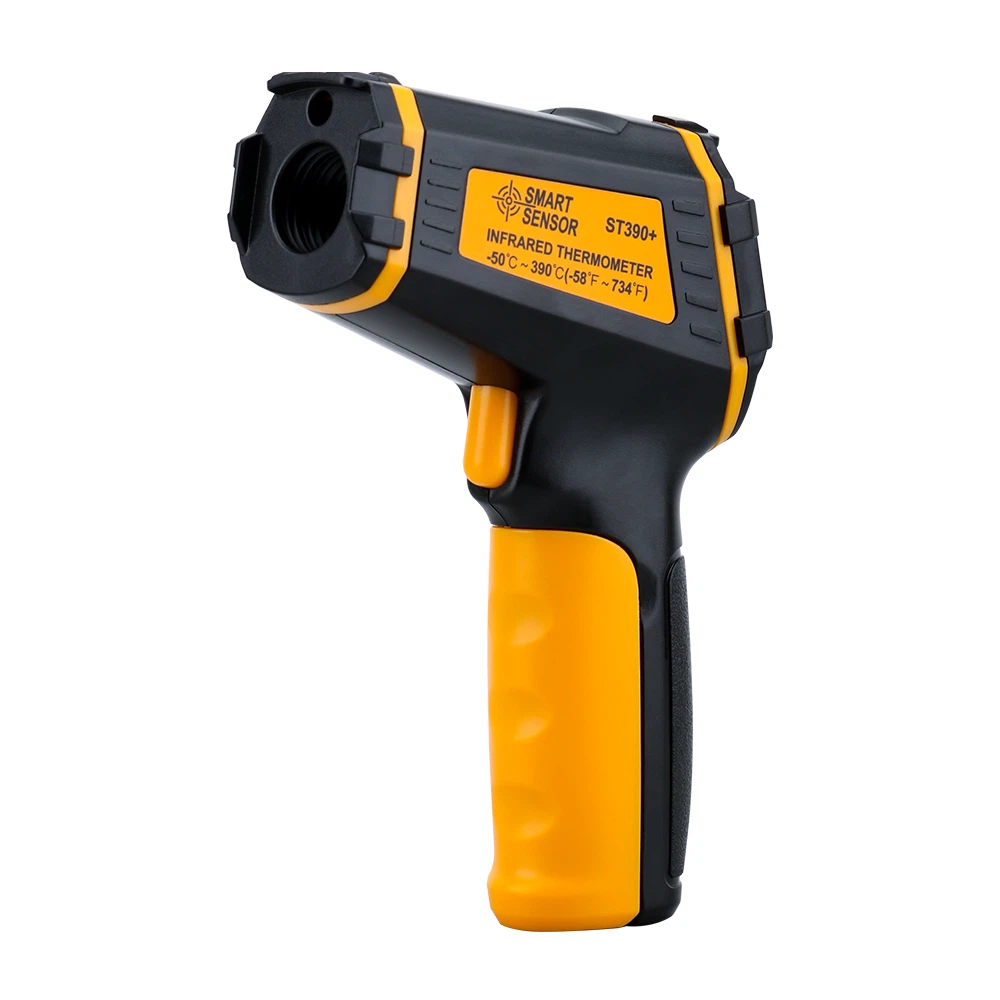
Working principle and system composition of infrared thermometer
The infrared thermometer is composed of optical system, photoelectric detector, signal amplifier, signal processing, display output and other parts. The optical system gathers the target infrared radiation energy in its field of view, and the size of the field of view is determined by the optical parts of the thermometer and its position. Infrared energy is focused on a photodetector and converted into a corresponding electrical signal. The signal passes through the amplifier and signal processing circuit, and is converted into the temperature value of the measured target after being corrected according to the algorithm of the internal treatment of the instrument and the emissivity of the target.
In nature, all objects with a temperature higher than the absolute zero are constantly emitting infrared radiation energy to the surrounding space. The size of the infrared radiation energy of an object and its distribution according to the wavelength have a very close relationship with its surface temperature. Therefore, by measuring the infrared energy radiated by the object itself, its surface temperature can be accurately determined, which is the objective basis for infrared radiation temperature measurement.
A blackbody is an idealized radiator that absorbs radiant energy of all wavelengths, has no reflection or transmission of energy, and has an emissivity of 1 on its surface. However, the actual objects in nature are almost not black bodies. In order to clarify and obtain the distribution law of infrared radiation, an appropriate model must be selected in theoretical research. This is the quantized oscillator model of body cavity radiation proposed by Planck, thus Derived the law of Planck's black body radiation, that is, the black body spectral radiance expressed by wavelength, which is the starting point of all infrared radiation theories, so it is called the law of black body radiation. The radiation amount of all actual objects depends not only on the radiation wavelength and the temperature of the object, but also on the type of material constituting the object, preparation method, thermal process, surface state and environmental conditions. Therefore, in order to make the law of black body radiation applicable to all practical objects, a proportional coefficient related to material properties and surface states must be introduced, that is, emissivity. This coefficient indicates how close the thermal radiation of the actual object is to the black body radiation, and its value is between zero and a value less than 1. According to the law of radiation, as long as the emissivity of the material is known, the infrared radiation characteristics of any object are known. The main factors affecting emissivity are: material type, surface roughness, physical and chemical structure, and material thickness.
When using an infrared radiation thermometer to measure the temperature of a target, it is first necessary to measure the infrared radiation of the target within its band range, and then the temperature of the measured target is calculated by the thermometer. A monochromatic pyrometer is proportional to the amount of radiation within a band; a two-color pyrometer is proportional to the ratio of the amount of radiation in the two bands.