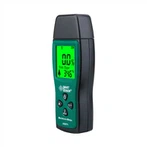
A suitable multimeter must be chosen for low frequency measurements.
The majority of contemporary multimeters can gauge AC impulses with 20Hz or lower frequencies. Lower frequency signals must, nevertheless, be measured for some purposes. You need to get the right multimeter and set it up correctly to perform these measurements. Think about the following instances:
True RMS measurements down to 3Hz are performed by the multimeter using digital sampling technology. The settling time in the slow filter is increased by the digital approach to 2.5s. You should pay attention to the following when measuring:
1. Choosing the proper AC filter is crucial. The rms converter's output is smoothed using filters. The appropriate setting for frequencies under 20Hz is LOW. A 2.5s delay is added when the LOW filter is selected to guarantee the multimeter's stability. Use the following command to set the low filter.
2. To expedite the measurement, you should set the manual range if you are aware of the signal's strength. Autoranging will move more slowly the longer the settling durations are between each low frequency measurement.
We recommend that you set manual range.
3. To test the DC signal, disable the ACRMS converter using a DC blocking capacitor. This enables the multimeter's range to measure the AC component. When monitoring sources with high output impedance, it's important to give the DC blocking capacitor enough time to settle. The frequency of the AC signal has no bearing on settling time, whereas any modifications to the DC signal do.
ACRMS voltage can be measured in three different ways, and its simultaneous sampling mode can detect signals as fast as 1Hz. Setting up the multimeter to measure low frequency:
Select the synchronous sampling mode:SET ACV: SYNC
2. The input signal for the ACV and ACDCV functions is DC coupled when you utilize the synchronous sampling mode. The DC component is mathematically subtracted from the reading in the ACV function. This is crucial to take into account because, even if the AC voltage is not overwhelmed, the combination of the DC and AC voltage levels may result in an overload state.
3. By choosing the proper range, you may shorten the measurement time because the automatic range feature will take longer while measuring low-frequency signals.
4. The multimeter must ascertain the signal period in order to sample the waveform. The pause value can be found with the ACBAND command. It's possible for the multimeter to pause before the waveform repeats if you don't use the ACBAND command.
5. The synchronous sampling mode triggers the synchronous signal using the level. False level triggers, which lead to inaccurate readings, can, nevertheless, be caused by noise in the input signal. It's crucial to pick a level that offers a dependable trigger source. For instance, the sine wave's peak should be avoided since noise can easily result in false triggers even though the signal varies gradually.
6. Use insulated test leads and ensure your environment is electrically "silent" in order to obtain the best readings. enables the level filtering function LFILTERON to lessen noise sensitivity.
An analog circuit with a DC blocking capacitor converts the rms voltage. Signals are measured down to 3Hz. Choose a low-frequency filter, range manually, and ensure that the various DC biases are steady to get the desired measurement results. A 7s delay is included while using the slow filter, maintaining the multimeter's stability.