Analysis of the Differences Between Analog Power Supplies, Switching Power Supplies, and Digital Power Supplies
In power supply design, the prerequisite for choosing a power module is to understand various power sources and their differences, so that we can correctly select the power module.
Simulated power supply: also known as transformer power supply, implemented through iron core and coil. The number of turns of the coil determines the voltage ratio at both ends. The role of the iron core is to transmit a changing magnetic field. In China, the main coil generates a changing magnetic field at a frequency of 50HZ, which is transmitted to the secondary coil through the iron core. This changing magnetic field generates induced voltage in the secondary coil, and the transformer achieves voltage transformation.
Disadvantages of analog power supply: The coil and iron core are conductors themselves, so they will generate heat (loss) due to self induced current during the process of converting voltage, so the efficiency of the transformer is very low, generally not exceeding 35%. The application of transformers in audio equipment amplifiers: High power amplifiers require transformers to provide more power output, which can only be achieved by increasing the number of coil turns and the volume of the iron core. Increasing the number of turns and the volume of the iron core will increase their losses. Therefore, transformers for high-power amplifiers must be made very large, which will result in bulky and high heat generation.
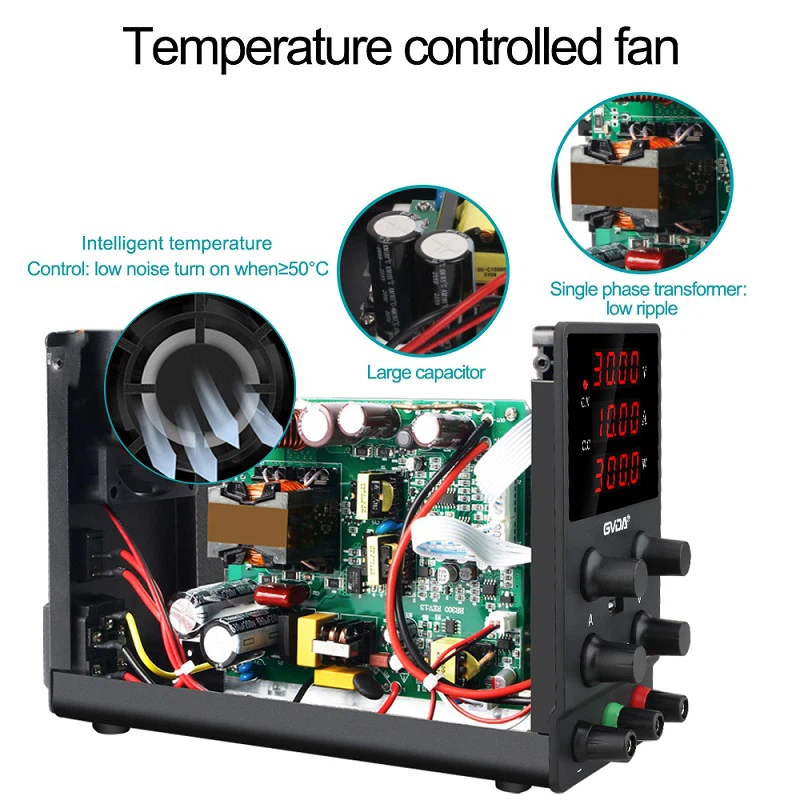
Switching power supply: Before the current enters the transformer, the switching function of the transistor is used to increase the frequency of our usual 50HZ current to tens of thousands of HZ. At such a high frequency, the frequency of magnetic field changes can also reach tens of thousands of HZ. This can reduce the number of coil turns and the volume of the iron core to obtain the same voltage conversion ratio. Due to the reduction of coil turns and iron core volume, losses are greatly reduced. Generally, the efficiency of switching power supply reaches 90%, and the volume can be made very small with stable output. Therefore, switching power supply has the advantages that analog power supply cannot achieve.