Application Scenarios, Benefits and Purposes of Clamp Meters
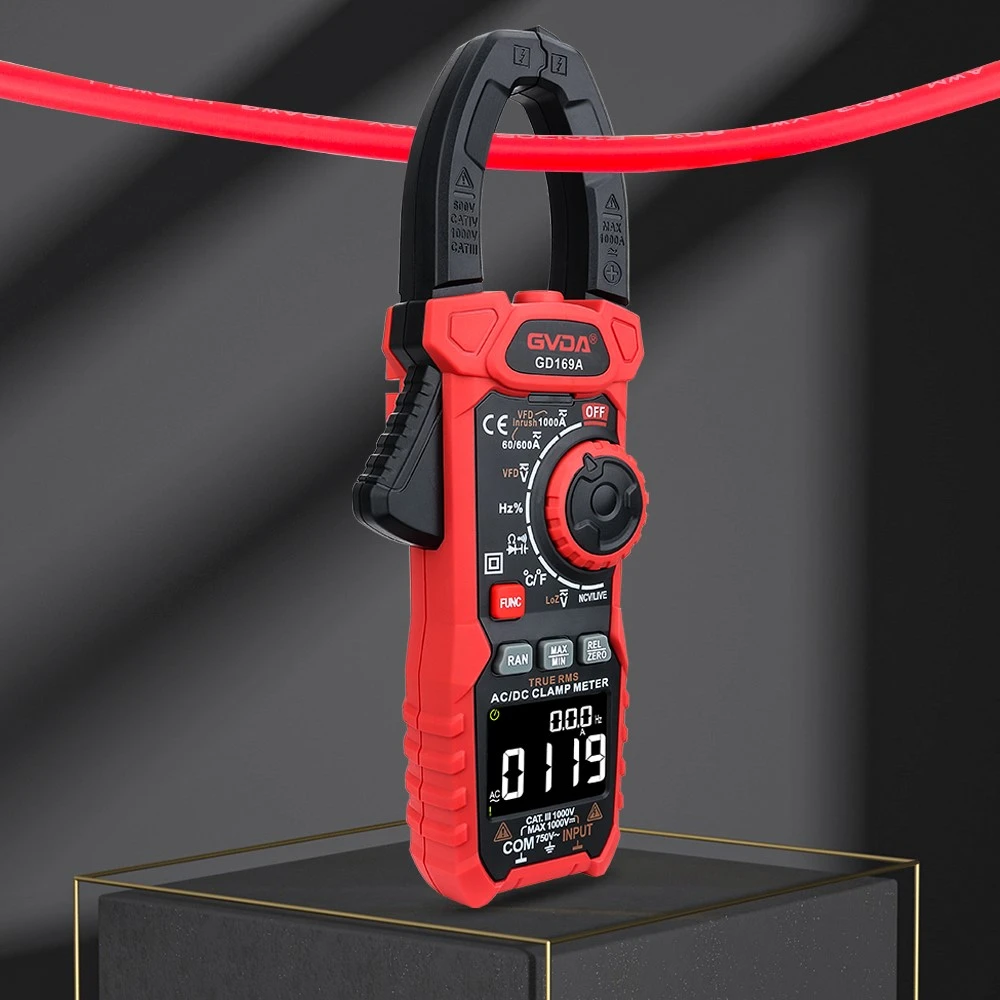
Most clamp meters incorporate the on‑site electrical diagnostic test functions of digital multimeters (DMMs). They can also connect to circuits and use test leads to measure voltage, current, frequency, capacitance, temperature and resistance (as well as continuous testing to check for circuit faults or missing connections). Equipped with a set of dedicated spring‑loaded jaws in various sizes, they can be clamped around wires or busbars for non‑intrusive current measurement.
Clamp meters are commonly used to measure AC and DC currents. AC clamp meters are mainly applied in public power supply systems, while DC clamp meters are widely used for industrial AC‑DC conversion motors, DC battery power supplies, DC power systems for electric vehicles, and DC batteries in solar arrays. Although a multimeter with test leads can take contact‑based current readings up to 10 A, a clamp meter delivers safer, non‑destructive current measurements up to 3000 A.
Some clamp meters are dedicated pure ammeters. They trade extra functions for smaller jaws, higher‑resolution readouts, better sensitivity and an overall compact pocket‑sized design. Other clamp meters adopt a flexible coil in place of rigid jaws. The long, pliable coil can be manually wrapped around tightly packed cables inside electrical cabinets where rigid jaws are hard to reach.
High‑quality clamp meters offer superior accuracy for demanding tasks. True‑RMS clamp meters can deliver precise equivalent DC effective values whether the current waveform is sinusoidal or non‑sinusoidal. When multiple conductors are bundled together, inductive coupling between wires can cause stray (or "ghost") voltages and inaccurate readings. The LoZ mode eliminates such errors. For industrial equipment driven by variable frequency drives (VFDs), the Lo‑Pass low‑pass filter mode improves measurement accuracy. Some models feature a built‑in directional non‑contact infrared thermometer (spot thermometer). Others support dual thermocouple inputs to calculate temperature difference (Δ‑T), an essential function for HVAC and refrigeration work.