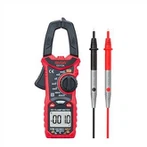
Does the true effective value of the clamp meter play a big role?
The most commonly asked questions while picking a clamp meter are "how accurate" and "accurate". The clamp meter's accuracy is influenced by a wide range of variables, including design and workmanship, bandwidth, frequency response, and the choice of an appropriate range, all of which have an impact on the reading. The correct RMS measurement, though, is among all of these criteria one of the most crucial, especially for industrial users with a wide range of electrical equipment and complex electrical surroundings.
The average response instrument, or non-true effective value, is mostly used to measure the sine wave of the standard power frequency. Converting the observed arithmetic mean reading of x1.1 into a sine wave "effective value" reading is a standard implementation principle. In an area where the electrification environment is pretty straightforward, such as buildings and properties, this is in no way a problem.
The need for accurate measurement has increased as the industrial environment has grown, especially with the use of more and more machinery like frequency converters, rectifiers, and inverters. As a result, the actual waveforms are becoming more and more diverse and even more high-frequency noises are being introduced.
Another crucial idea that needs to be brought up when discussing noise or harmonics is the low-pass filter (LPF). The implication is that the high-frequency portion will be shut off and cannot be calculated, and that only the low-frequency current and voltage can be monitored. The 'real RMS' is said to be only truly valuable in a true RMS clamp meter with low-pass filtering.