Explanation of the main criteria for selecting a thermometer
The application of a thermometer is mainly determined by the measurement range. Whether it is the measurement voltage or the initial value of the measurement area, it should comply with the requirements of the measurement work. The larger the measurement voltage, the smaller the resolution, and thus the accuracy is poor. Especially when measuring the initial value of a low temperature, choosing a larger measurement voltage will greatly reduce the accuracy. Therefore, it is recommended to choose the smallest possible measurement voltage.
The initial value of the measurement area determines the sensitivity of the spectrum and even the model of the detector. The measurement error is significantly smaller in short wave sensors than in long wave sensors due to incorrect adjustment of emissivity. Therefore, in hot film sensors (8-14 μ m) At 800 ℃, due to the measurement error caused by incorrect adjustment of emissivity, sensors (1,1-1,6 μ m) . The allowable measurement range of the germanium photodiode sensor is around 250 ℃.
For example, in the ceramic industry or power plant combustion process, the measurement range is usually between 0 and 1300 ℃. To avoid large errors, a shortwave detector thermometer should be selected. Although its high temperature measurement ranges from 250 to 1300 ℃
Another criterion for selecting a suitable thermometer is the spacing ratio. This refers to the proportional relationship between the measurement distance and the diameter of the measurement point. If the measured object is small, the measurement distance is large, or the so-called "hot spot" is on a large area, then a large spacing ratio is required. On the contrary, if there are large measurement points, due to the stable output signal of the sensor to the measurement points, a small spacing ratio should be chosen.
Furthermore, it should be determined whether the thermometer is equipped with a sight device, as the sight device will increase the cost by 50%. The key here is the price. When measuring large areas of objects, it is usually not necessary to assemble the sight device, and instead, an external sight device will be used to correct the thermometer during installation, which has a price advantage. Many measurement points only require one sight device.
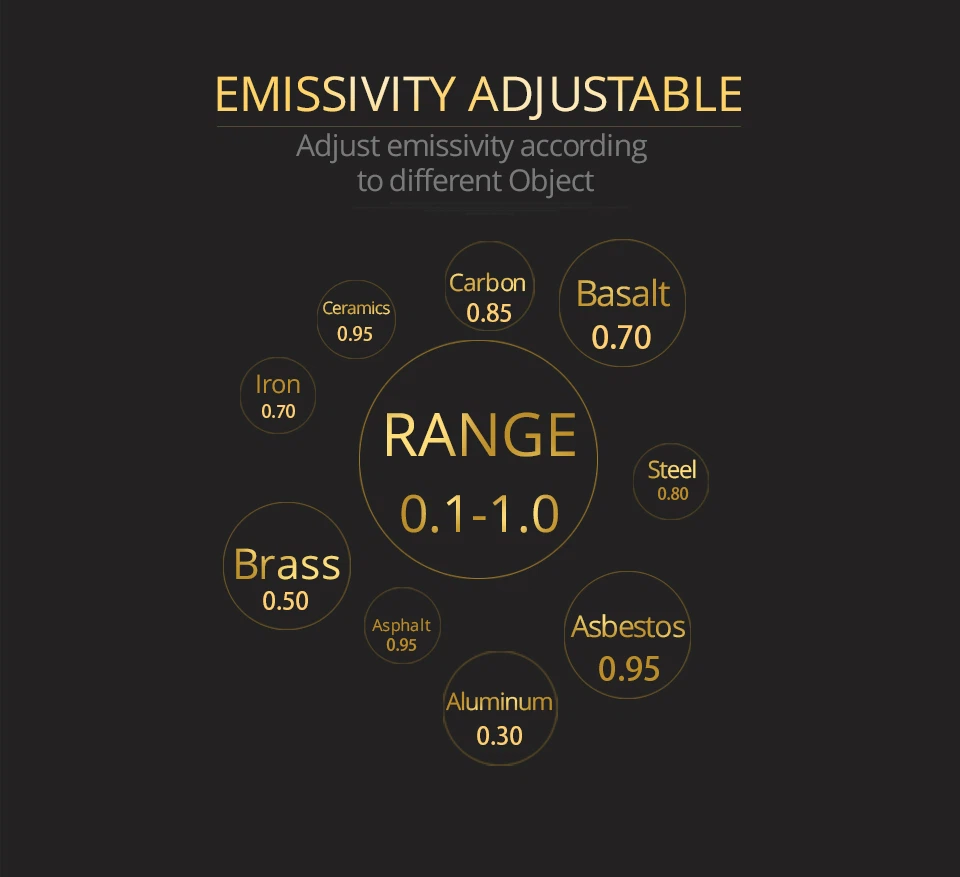
It is possible to aim small measuring objects or distant measuring distances at any time. In a transparent mirror with a dashboard scale, people can clearly see the actual size of the measurement point. The cheaper option is to use a laser to point at the point, but it can only be measured point by point. When measuring similar devices such as closed furnaces, a window is required. From this, it needs to be decided whether a thermometer is needed and what functions does South Africa need? For functions such as leveling, special value storage, boundary contact, or computer interface, it is necessary to adjust the emissivity for the suitability of the thermometer to measure the surface of the object. Other functions can be achieved cheaply by connecting recorders, regulators, or programmable computers. In addition, for some applications, the external structure is also a determining factor. At higher ambient temperatures, the thermometer only has an optical part with the lens, and is connected to the electrical part by an optical cable. It is placed away from high temperature areas, and the advantage is that it can save cooling devices.