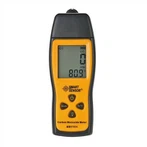
How to Use Multimeter to Measure Ground Resistance
In many cases, it is necessary to bury grounding bodies and lead out grounding levels in order to reliably ground instruments and equipment. To ensure that the grounding resistance meets the requirements, a dedicated grounding resistance tester (such as Japan's Kyoritsu 4105A) is usually needed for measurement. But in practical work, specialized grounding resistance testers are expensive and difficult to find. Can a multimeter be used to measure grounding resistance? The author conducted experiments on the grounding resistance of different soil types using a multimeter, and compared the data measured by the multimeter with that measured by a dedicated grounding resistance tester. The two were found to be very close. The specific measurement method is as follows: Find two round steel bars that are 8mm and 1m long, sharpen one end of them as an auxiliary testing rod, and insert them into the underground 5m away from both sides of the grounding body A to be tested, with a depth of at least 0.6m, and keep the three in a straight line. Here, A is the grounding body to be tested, B and C are auxiliary test rods, and then use a multimeter (R * 1 gear) to measure A and B; The resistance values between A and C are denoted as RAB, RAC, and RBC, respectively. After calculation, the grounding resistance value of grounding body A can be determined. Since grounding resistance refers to the contact resistance between the grounding body and the soil. Let the grounding resistances of A, B, and C be RA, RB, and RC, respectively. Let the soil resistance between A and B be RX again, because the distance between AC and AB is equal, the soil resistance between A and C can also be RX; Since BC=2AB, the soil resistance between B and C is approximately 2RX, then RAB=RA+RB+RX... ① RAC=RA+RC+RX...... ② RBC=RB+RC+2RX...... ③ Combining ①+② - ③ yields: RA=(RAB+RAC - RBC)/2... ④ ④ The formula is the calculation formula for grounding resistance. Actual test example: The data obtained for a certain grounding body today are as follows: RAB=8.4 ∩, RAC=9.3 ∩, RBC=10.5 ∩. So: RA=(8.4+9.3-10.5)/2=3.6 (∩), therefore, the grounding resistance value of the tested grounding body A is 3.6 ∩. It is worth noting that before measurement, the three grounding bodies A, B, and C need to be polished with sandpaper to minimize the contact resistance between the probe and the grounding body and reduce errors.