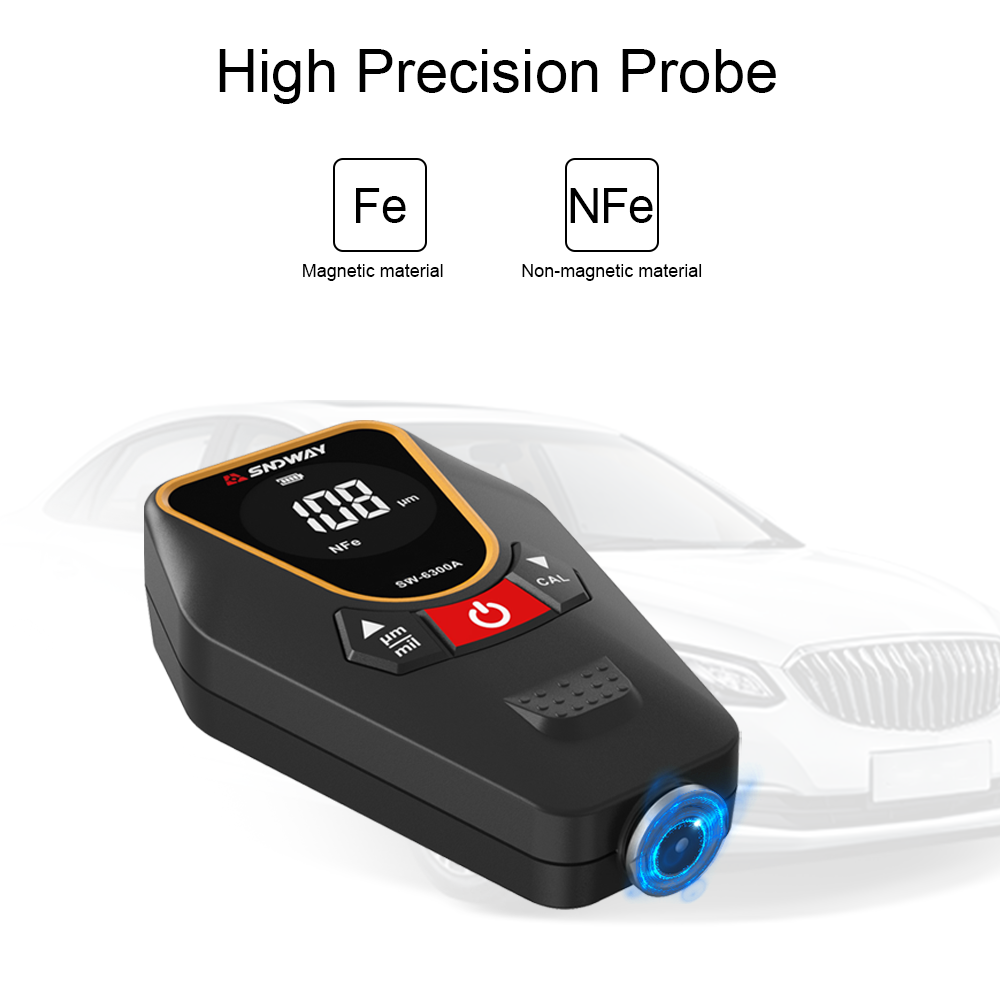
How to use the coating thickness gauge to avoid or reduce errors
When using the coating thickness gauge to measure, try to use the measured material as the zero-adjusting substrate to prevent the measurement error due to the different magnetic permeability caused by different materials. Wait until the same part of the material to be measured is zeroed, and then carry out the measurement of the same part, such as the edge and middle part of the workpiece on the side face should be zeroed separately.
When using a coating thickness gauge for measurement, it should also be noted that the probe and the surface of the material to be measured are kept vertical to avoid large errors. If the measurement is at the same point, the probe can be separated by more than 10 cm each time, and the measurement should be carried out after a few seconds, so as to avoid the measurement result being affected by the magnetization of the probe of the material under test.
The outer surface of the coating thickness gauge used for zero adjustment needs to be kept as smooth as possible. If the outer surface is not smooth, the average value should be taken according to the situation, because the roughness of the outer surface has a great influence on the measured value. Different structures should carry out zero-adjustment measurement, plane zero-adjustment side face plane, measurement of concave surface after zero-adjustment, measurement of convex surface after zero-adjustment, to prevent errors in measurement due to different structures.
The basic structure of the coating thickness gauge is composed of magnetic steel, relay spring, scale and automatic stop mechanism. After the magnetic steel is attracted to the measured object, the measuring spring is gradually elongated thereafter, and the pulling force is gradually increased. When the pulling force is just greater than the attractive force, the coating thickness can be obtained by recording the pulling force at the moment when the magnetic steel is detached.
This instrument is characterized by easy operation, durability, no power supply, no calibration before measurement, relatively low price, and is very suitable for on-site quality control in workshops.
What are the factors affecting the measurement of coating thickness gauge
a) Magnetic properties of the base metal
The magnetic thickness measurement is affected by the magnetic change of the base metal (in practical applications, the magnetic change of low carbon steel can be considered slight), in order to avoid the influence of heat treatment and cold working factors, it should be used with the same properties as the test piece base metal The standard sheet is used to calibrate the instrument; the test piece to be coated can also be used for calibration.
b) Electrical properties of the base metal
The conductivity of the base metal affects the measurement, and the conductivity of the base metal is related to its material composition and heat treatment method.
The instrument is calibrated using a standard sheet having the same properties as the base metal of the test piece.
c) base metal thickness
Every instrument has a critical thickness of the base metal. Above this thickness, the measurement is not affected by the thickness of the base metal.
d) Edge effects
The instrument is sensitive to abrupt changes in the surface shape of the test piece. It is therefore unreliable to measure near the edge or inside corners of the test piece.
e) Curvature
The curvature of the test piece has an effect on the measurement. This effect always increases significantly with decreasing radius of curvature. Therefore, measurements on the surface of curved test pieces are not reliable.
f) Deformation of the test piece
The measuring head deforms soft-covered specimens, so reliable data can be measured on these specimens.
g) Surface roughness
The surface roughness of the base metal and the coating has an effect on the measurement. The greater the roughness, the greater the impact.
Rough surface will cause systematic error and accidental error, and the number of measurements should be increased at different positions for each measurement to overcome this accidental error.
If the base metal is rough, it is necessary to take several positions on the uncoated base metal test piece with similar roughness to calibrate the zero point of the instrument; or use a solution that does not corrode the base metal to dissolve and remove the covering layer, and then calibrate the instrument. zero.
h) magnetic field
The strong magnetic field generated by various electrical equipment around will seriously interfere with the magnetic thickness measurement work.
i) Adhesive substances
The instrument is sensitive to the attached substances that hinder the close contact between the measuring head and the surface of the covering layer. Therefore, the attached substances must be removed to ensure that the measuring head of the instrument is in direct contact with the surface of the test piece.
j) Measuring head pressure
The pressure exerted by the measuring head on the test piece will affect the reading of the measurement, so the pressure should be kept constant.
k) Orientation of the measuring head
The way the measuring head is placed has an effect on the measurement. During the measurement, the measuring head should be kept perpendicular to the surface of the sample.