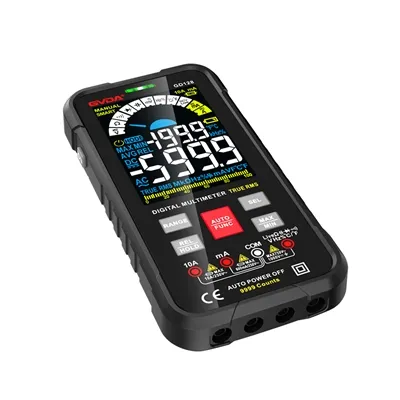
How to use the multimeter's resistance file
The working principle of the meter resistance file uses a sensitive magnetoelectric DC ammeter (microampere meter) as the meter head. When a small current passes through the meter head, there will be a current indication. However, the meter head cannot pass a large current, so some resistors must be connected in parallel or in series on the meter head to shunt or lower the voltage, so as to measure the current, voltage and resistance in the circuit.
Because the meter is a DC meter, when measuring AC, it is necessary to install a parallel and serial half-wave rectifier circuit to rectify the AC into DC and then pass through the meter, so that the AC voltage can be measured according to the magnitude of the DC. The method of extending the AC voltage range is similar to the DC voltage range.
Connect appropriate resistors in parallel and in series on the meter head, and connect a battery in series at the same time, so that the current passes through the measured resistance, and the resistance value can be measured according to the magnitude of the current. Changing the resistance value of the shunt resistor can change the range of the resistance.
The multimeter is a relatively precise instrument. If it is not used properly, it will cause inaccurate measurement and is easily damaged. However, as long as you master the use method and precautions of the multimeter and do it carefully, the multimeter can be durable.
When using a multimeter, the following items should be paid attention to:
1. Measuring current and voltage cannot be rotated in the wrong gear. If you mistakenly use the resistance gear or the current gear to measure the voltage, it is very easy to burn out the ammeter. When the multimeter is not in use, it is best to turn the gear to the highest level of AC voltage to avoid damage due to improper use.
2. When measuring DC voltage and DC current, pay attention to the polarity of "+" and "-", and do not connect them wrongly. If the pointer is found to be reversed, the watch stick should be replaced immediately to avoid damage to the pointer and the watch head.
3. If you do not know the magnitude of the voltage or current to be measured, you should use the highest gear first, and then select a suitable gear for testing, so as to avoid damage to the meter due to excessive deflection of the hands. The closer the selected gear is to the measured value, the more accurate the measured value will be.
When the multimeter is in the resistance range, the internal resistance is very different. How does the internal resistance change in the resistance range?
The resistance file of the multimeter is equivalent to the resistors of different resistance values in series with the battery, and finally connected in series with the circuit under test. The lower the range (R×1), the smaller the current limiting resistor connected in series with the battery of the multimeter, and the larger the current that can be output. For example, the current limiting resistance of MF50 meter R×1 is approximately equal to 8.9Ω, and the current of about 150mA can be output when the test leads are short-circuited. The larger the measuring range (R×1k), R×10k), the larger the resistance in series, the output current capability is much smaller than the R×1 range, and the MF50 probe only has a current of 150 microamps when it is short-circuited.