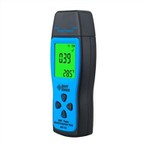
Instructions for use of clamp meter
1. Read the instruction manual carefully before use to find out whether it is AC or AC/DC dual-use.
2. The voltage of the circuit under test cannot exceed the value marked on the clamp meter, otherwise it may easily cause a grounding accident or cause an electric shock hazard.
3. Only the current of one phase wire can be measured at a time, and the wire to be tested should be placed in the center of the clamp window, and multi-phase wires cannot be clamped into the window for measurement.
4. Before measuring with the clamp meter, you should first estimate the magnitude of the measured current, and then decide which range to use. If it is impossible to estimate, you can first use the largest range file and then change it to a smaller one to get an accurate reading. It is not possible to use the low current gear to measure large currents. to prevent damage to the meter.
5. The jaws should be closed tightly during measurement. If there is any noise after closing, you can open the jaws and repeat it again. If the noise still cannot be eliminated, you should check whether the joint surfaces on the magnetic circuit are smooth, and wipe them clean if there is dust.
6. Due to the low precision of the clamp ammeter itself, the following method can be used when measuring small currents: first wind the wire of the circuit under test several times, and then put it into the jaw of the clamp meter for measurement. At this time, the current value indicated by the clamp meter is not the actual value being measured. The actual current should be the reading of the clamp meter divided by the number of turns of the wire.
7. When the clamp meter is measuring, the current of the nearby wires will also affect it, so it is also necessary to pay attention to the equal position of the three-phase wires.
8. Do not operate with electricity during maintenance to prevent electric shock.
What True RMS Means for HVAC
Consider all the problems found in complex HVAC and refrigeration systems. Naturally, not only are there a myriad of electrical and mechanical issues, but also control system issues, air supply balance issues, compressor performance and coolant temperature and pressure, superheat, subcooling, and air movement that are fundamental to air conditioning and refrigeration performance The fine balance between and many other issues. Now consider how many of these problems involve nonlinear loads. Essentially, any controller or system that includes semiconductors in the power section can be considered a nonlinear load. Often When Troubleshooting HVAC Equipment Faults Often, when troubleshooting HVAC equipment malfunctions or annoying trips caused by electrical problems, your first instinct is to expect a tripped or overloaded circuit breaker at the switchboard. However, if there is a non-linear load on the circuit, a true rms test tool is needed to safely measure the true load current to determine what the problem is: Is the circuit malfunctioning? Circuit overloaded? Problem with the load itself?