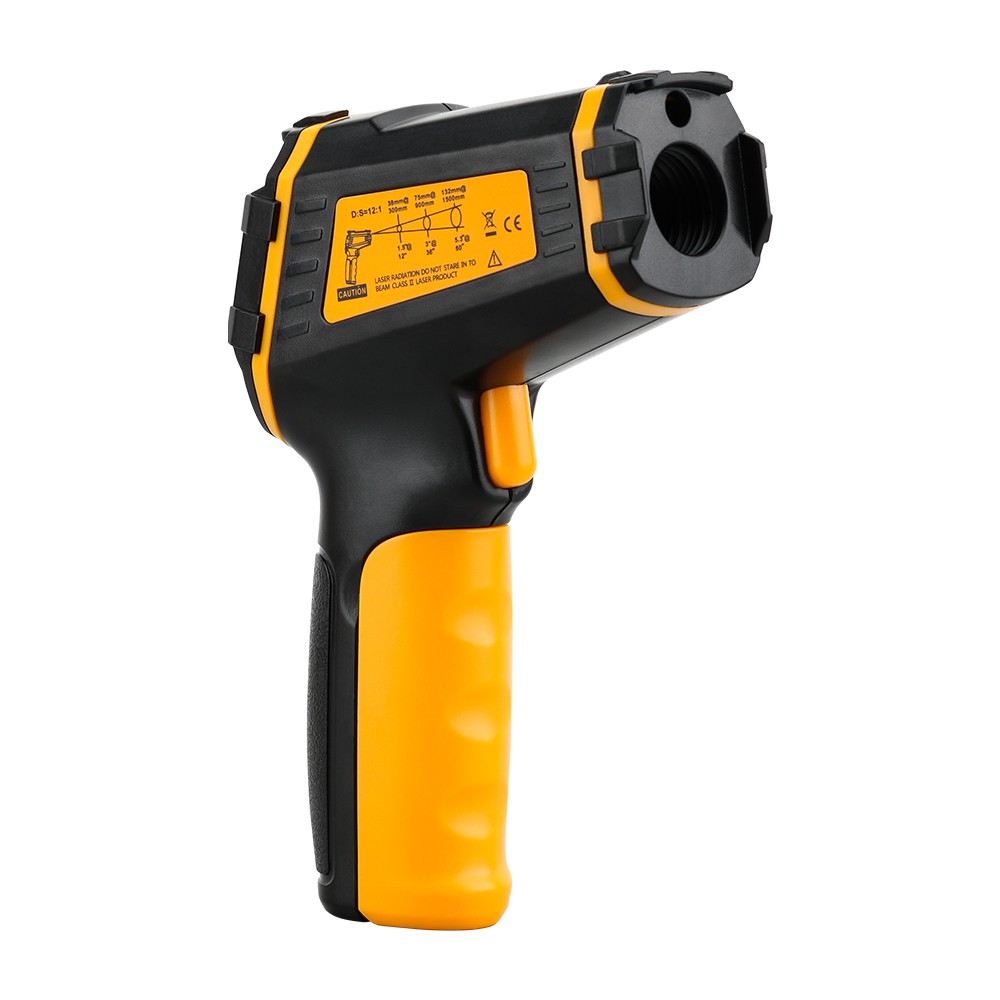
Introduction to the Principle and Structure of Infrared Thermometers
1. Sight
The sight has this function. The measuring block or point pointed by the thermometer can be seen, and a large area of the object being measured can often be avoided without the sight. It is recommended to use a sight with instrument panel markings or laser pointing points in the form of a transparent mirror when measuring small objects and long distances.
2. Lens
The lens determines the measured point of the thermometer. For large objects, a thermometer with a fixed focal length is generally sufficient. But when measuring distance away from the focal point, the image at the edge of the measurement point will be unclear. For this reason, it is better to use a zoom lens. Within the given zoom range, the thermometer can adjust the measurement distance. The new thermometer comes with a replaceable zoom lens, and the near and far lenses can be replaced without calibration and retesting.
3. Sensor, i.e. spectral receiver
Temperature is inversely proportional to wavelength. At low object temperatures, sensors sensitive to long wave spectral regions (such as hot film sensors or thermoelectric sensors) are suitable. At high temperatures, photoelectric sensors composed of germanium, silicon, indium gallium, etc. that are sensitive to short waves will be used.
When selecting spectral sensitivity, it is also necessary to consider the absorption spectral bands of hydrogen and carbon dioxide. Within a certain wavelength range, known as the 'atmospheric window', H2 and CO2 are almost transparent to infrared radiation. Therefore, the sensitivity of the thermometer to light changes must be within this range to eliminate the influence of atmospheric concentration changes. When measuring thin films or glass, it is also necessary to consider that these materials are not easily penetrated within a certain wavelength range. In order to avoid measurement errors caused by background light, suitable sensors that only receive surface temperature should be used. Metals have this physical property, and emissivity increases with decreasing wavelength. Based on experience, when measuring the temperature of metals, a shorter measurement wavelength is generally chosen.