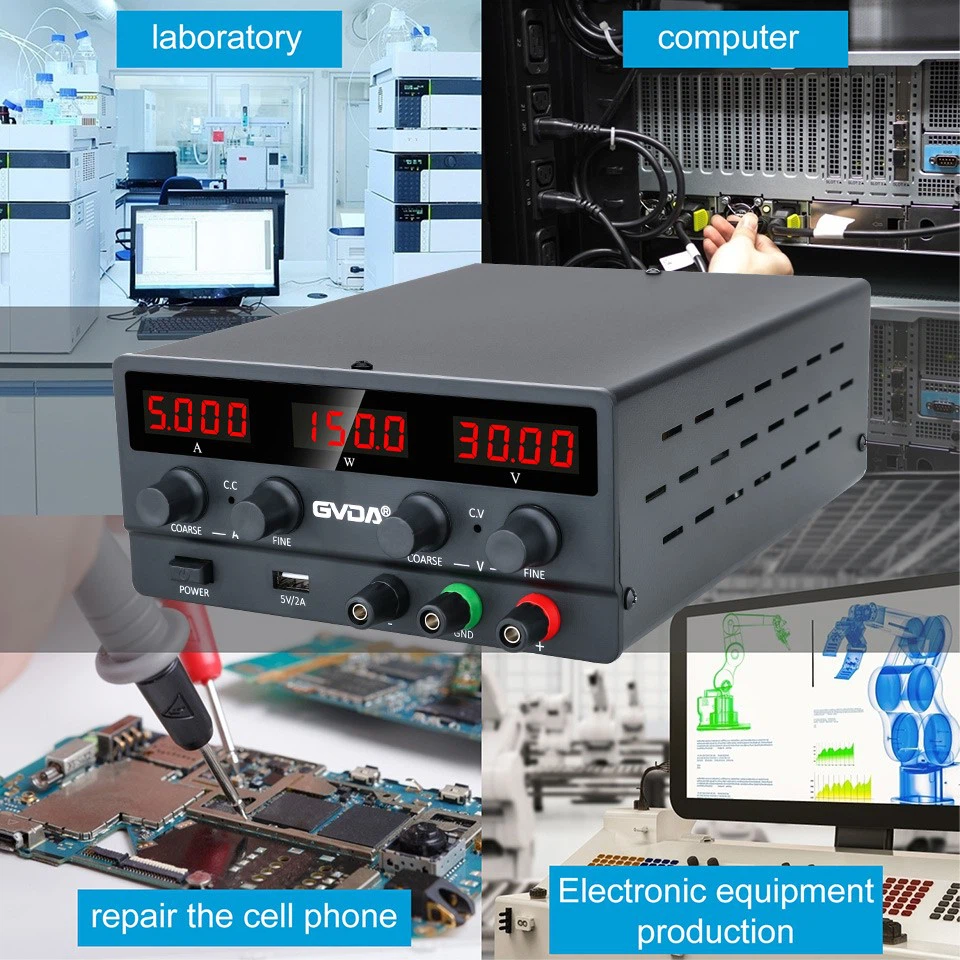
Introduction to the working principle of regulated power supply
The working process of the switching power supply is quite easy to understand. In the linear power supply, the power transistor is allowed to work in linear mode. Different from the linear power supply, the pWM switching power supply allows the power transistor to work in the on and off states. In these two In the state, the volt-ampere product added to the power transistor is very small (when it is turned on, the voltage is low and the current is large; when it is turned off, the voltage is high and the current is small)/The volt-ampere product on the power device is the power semiconductor losses on the device. Compared with linear power supplies, the more efficient working process of pWM switching power supplies is achieved by "chopping", that is, chopping the input DC voltage into a pulse voltage whose amplitude is equal to the input voltage amplitude. The duty cycle of the pulse is adjusted by the controller of the switching power supply. Once the input voltage has been chopped into an AC square wave, its amplitude can be increased or decreased through the transformer. By increasing the number of secondary windings of the transformer, the number of output voltage groups can be increased. Finally, these AC waveforms are rectified and filtered to obtain the DC output voltage. The main purpose of the controller is to keep the output voltage stable, and its working process is very similar to the linear form of the controller. This means that the controller's functional blocks, voltage reference, and error amplifier can be designed to be identical to those of a linear regulator. The difference between them is that the output of the error amplifier (error voltage) passes through a voltage/pulse width conversion unit before driving the power tube. There are two main working modes of switching power supply: forward conversion and boost conversion. Although there is little difference in the arrangement of their parts, their working processes vary greatly, and each has its own advantages in specific applications.
Classification of switching power supplies
In the field of switching power supply technology, people are developing related power electronic devices and switching frequency conversion technology at the same time. The two mutually promote each other and promote the switching power supply to be light, small, thin, low noise, high reliability, development in the direction of anti-interference. Switching power supplies can be divided into two categories: AC/DC and DC/DC. There are also AC/ACDC/AC such as inverters and DC/DC converters. Now they are modular, and the design technology and production process are mature and mature at home and abroad. Standardization and has been recognized by users, but the modularization of AC/DC, due to its own characteristics, encounters relatively complex technical and process manufacturing problems in the process of modularization. The structures and characteristics of the two types of switching power supplies are described below.