Measurement technology of anemometers and their selection guide
The flow velocity measurement range of 0 to 100m/s can be divided into three zones: low speed: 0 to 5m/s; medium speed: 5 to 40m/s; high speed: 40 to 100m/s. The thermal probe of anemometer is used for the measurement of 0 to 5m/s; the rotary probe of anemometer is ideal for measuring the flow velocity from 5 to 40m/s; and the use of Pitot tube can get the best result in the high speed range. The use of a Pitot tube gives the best results in the high speed range. An additional criterion for the correct selection of an anemometer's flow velocity probe is the temperature, typically the thermal sensor of an anemometer is used at temperatures up to about +-70 C. Specialised anemometers have rotor probes up to 350 C. Pitot tubes are used at temperatures of +350 C and above.
Thermal Probes for Anemometers
The principle of operation of the thermal probe of anemometers is based on the fact that the cold impulse air flow carries away the heat from the thermal element, and with the help of a regulating switch, which keeps the temperature constant, the regulating current is directly proportional to the flow rate. When using a thermal probe in turbulent flow, air currents from all directions simultaneously impinge on the thermal element, thus affecting the accuracy of the measurement results. When measuring in turbulence, the thermal anemometer flow rate sensor tends to show a higher value than the rotating wheel probe. The above phenomenon can be observed during duct measurements. Depending on the different designs used to manage duct turbulence, they can occur even at low speeds. Therefore, the anemometer measurement process should be carried out in a straight part of the duct. The starting point of the straight section shall be at least 10 x D (D = pipe diameter in CM) away in front of the measurement point; the end point shall be at least 4 x D behind the measurement point. The fluid section shall not be obstructed in any way. (corners, heavy overhangs, objects, etc.)
Rotating Wheel Probes for Anemometers
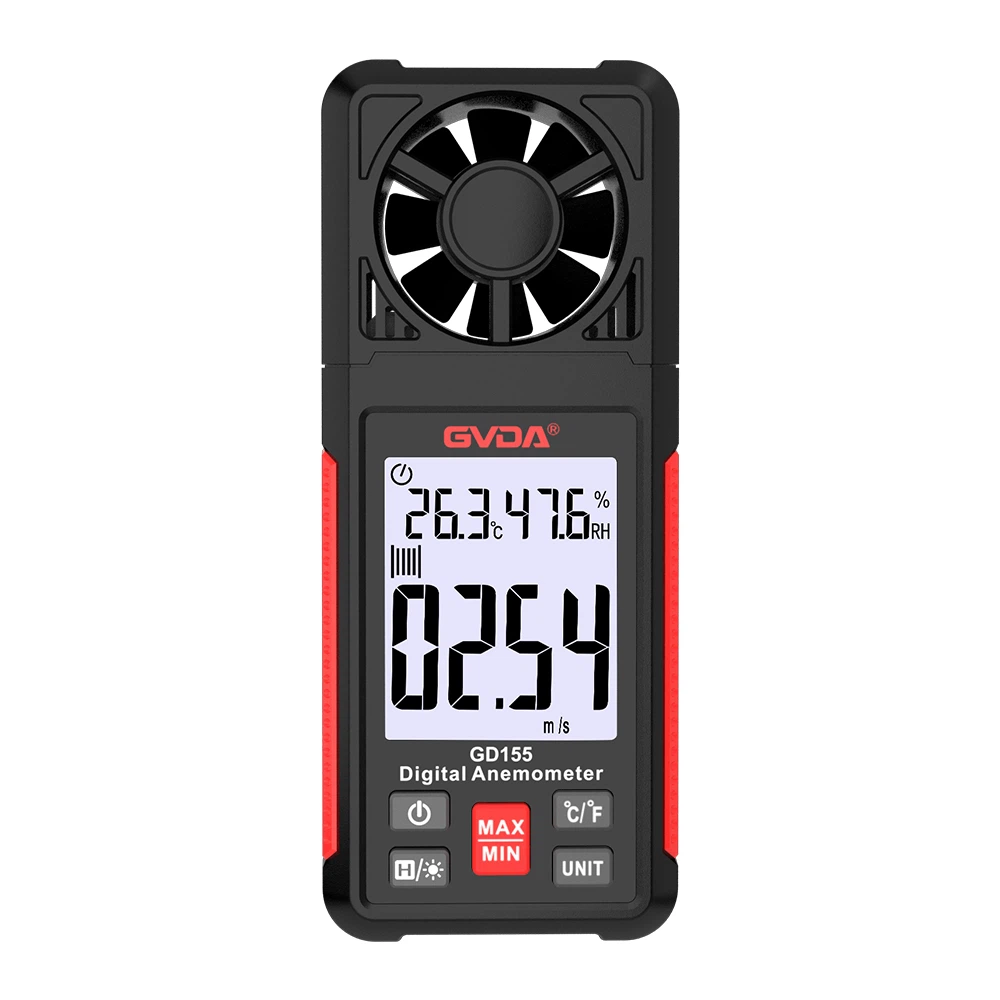
The working principle of the anemometer's rotating wheel probe is based on the conversion of the rotation into an electrical signal, which is first passed through a proximity inductor, "counting" the rotation of the wheel and generating a series of pulses, which are then converted and processed by the detector to obtain the value of the rotational speed. The large diameter probes of the anemometers (60mm, 100mm) are suitable for the measurement of turbulent flows (e.g. at the outlet of pipelines) at medium and small flow velocities. The small diameter probes of anemometers are more suitable for measuring airflow where the cross-section of the pipe is more than 100 times larger than the cross-section of the probe.
Positioning of the anemometer in the air stream
The correct adjustment position of the anemometer's rotating probe is with the airflow parallel to the rotating wheel axis. When the probe is gently rotated in the air stream, the reading changes. When the reading reaches the maximum value, the probe is in the correct measuring position. When measuring in a pipe, the distance from the starting point of the straight part of the pipe to the measurement point should be greater than 0XD, turbulence on the anemometer's thermal probe and Pitot tube has relatively little effect.
Measurement of airflow velocity of anemometer in a pipe
It has been proved that the 16mm probe of anemometer is widely used. Its size ensures good permeability and can withstand flow velocities of up to 60 m/s. The measurement of air velocity in ducts is one of the feasible measurement methods, and indirect measurement protocols (grid measurement) are applicable to air measurements.