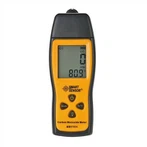
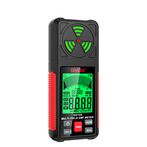
Merits of Conventional Multimeters vs Digital Multimeters
A digital multimeter is an instantaneous sampling instrument. It takes a sample every 0.3 seconds to display the measurement result. Sometimes the sampling results are only very close rather than identical, making it less convenient to read values compared with analog multimeters.
Analog multimeters generally have no built-in amplifiers and thus feature low internal resistance. For example, the Model MF-10 has a DC voltage sensitivity of 100 kΩ/V, which is already excellent. The Model MF-500 has a DC voltage sensitivity of 20 kΩ/V.
Digital multimeters employ operational amplifier circuits internally, so their internal resistance can be made very high, often 1 MΩ or higher (which delivers higher sensitivity). This minimizes interference with the circuit under test and enables higher measurement accuracy.
With low internal resistance and shunt/voltage divider circuits built mostly from discrete components, analog multimeters have non-uniform frequency characteristics (compared with digital types).
Analog multimeters have a simple internal structure, resulting in low cost, fewer functions, easy maintenance, and strong resistance to overcurrent and overvoltage.
Digital multimeters integrate various oscillator, amplification, frequency division and protection circuits, offering abundant functions such as temperature measurement, frequency measurement (within a low range), capacitance measurement, inductance measurement, and even signal generation.
Since integrated circuits are widely adopted in their internal structure, digital multimeters have poor overload resistance. (However, some modern models support auto-ranging and automatic protection. They are relatively complex to operate and generally difficult to repair once damaged.)
Digital multimeters output a low voltage (typically no more than 1 V), which creates inconvenience for testing certain components with special voltage characteristics (such as silicon controlled rectifiers and light-emitting diodes).
Analog multimeters provide a higher output voltage (10.5 V, 12 V, etc.) and larger output current (for instance, approximately 100 mA at the ×1 Ω range of MF-500). They can conveniently test silicon controlled rectifiers, light-emitting diodes and other components.