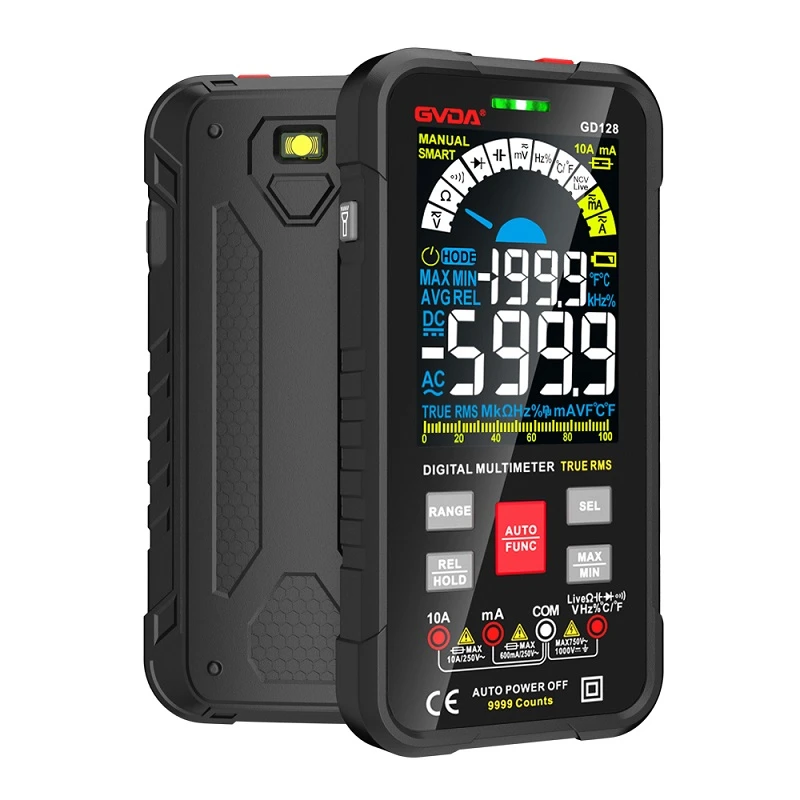
One Simple Rule for Choosing a Multimeter
The general rule for multimeter selection is straightforward: its performance parameters shall meet requirements and adapt to the operating environment.
Select the display digits and resolution according to the actual application environment and scope Display digits and resolution are key performance indicators to consider when buying a multimeter. Generally, more display digits correspond to higher measurement accuracy. For applications requiring high precision, choose a multimeter with higher digits and resolution, which usually comes at a higher price. For routine measurement tasks such as repairing televisions, induction cookers and other electrical appliances, a 3½‑digit multimeter is sufficient.
Select the AC amplitude specification and frequency response based on measurement requirements Most multimeters perform similarly for resistance, DC voltage and DC current tests. However, AC signal measurement is more complex; frequency response and amplitude conversion factors must be considered as the signal frequency varies. Multimeters are classified by AC measurement principle: average‑responding multimeters and true‑RMS multimeters.
① Average‑responding multimeters are designed mainly for pure sine waves. They calculate AC signals by averaging and will produce significant errors for non‑sinusoidal waveforms. Measurement error also increases greatly when harmonic distortion exists in sine wave signals.
② True‑RMS multimeters calculate current and voltage by multiplying the instantaneous peak value of the waveform by 0.707, enabling accurate readings under distorted and noisy conditions. Based on the above differences, users shall select a multimeter with the proper measurement principle and AC frequency response according to the measured signal type and required accuracy.
③ Select functions and measurement ranges as needed As mentioned above, multimeters vary in functions and measurement ranges by type and grade. Ordinary multimeters are adequate for basic tests of current, voltage, resistance and continuity. For electronic measurement work involving diodes, transistors and other components, choose a multimeter equipped with diode test, transistor hFE, frequency and temperature measurement functions.
Following this principle will help you avoid confusion when purchasing a multimeter, and hopefully the above guidance will be useful to you.