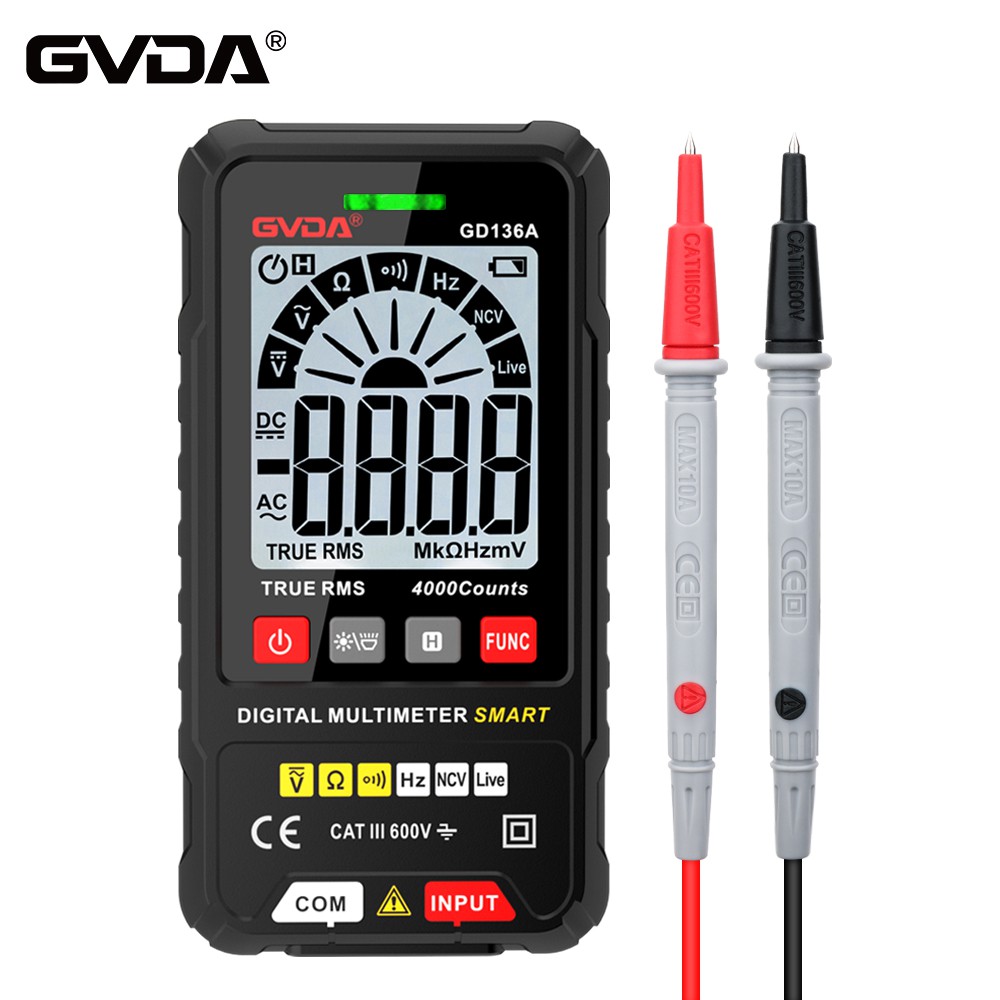
Precautions for Resistance Measurement with Multimeter
1. When a resistor is connected in a circuit, the power supply of the circuit should be disconnected first, and live measurement is never allowed. If measuring with electricity, it is easy to burn out the multimeter and make the measurement results inaccurate.
2. The positive pole of the dry battery in the multimeter is connected to the "-" socket on the panel, and the negative pole of the dry battery is connected to the "+" socket on the panel. When measuring the resistance of devices such as electrolytic capacitors and transistors, attention should be paid to polarity.
3. Every time the magnification level is changed, the Ohm zeroing must be performed again.
4. It is not allowed to directly measure the internal resistance of high-sensitivity meter heads using the resistance range of a multimeter. Because doing so may cause the current flowing through the meter to exceed its capacity (microampere level) and burn out the meter.
5. It is not allowed to hold the metal part of the probe with both hands at the same time to measure resistance, otherwise it will connect the human body resistance to the measured resistance and cause measurement errors. This is because the measured resistance value is the equivalent resistance value of the parallel connection of the human body resistance and the measured resistance, rather than the resistance value of the measured resistance.
6. Resistance may cause significant deviation during road measurement, as the measured resistance value is the equivalent resistance value of the partial circuit resistance connected in parallel with the tested resistance, rather than the resistance value of the tested resistance. *Okay, solder open one pin of the resistor for measurement.
7. When measuring the equivalent resistance of nonlinear components using a multimeter at different magnifications in the ohm range, the measured resistance values are not the same. This is due to the different median resistance and full-scale current of each gear. In mechanical meters, the smaller the magnification, the smaller the measured resistance value (see the content of crystal diodes and transistors for details).
8. When measuring the equivalent resistance of polarized components such as transistors and electrolytic capacitors, attention must be paid to the polarity of the two pens (see the capacitor quality discrimination section for specific details).
9. After the measurement is completed, place the conversion switch at the AC voltage zero or neutral position.