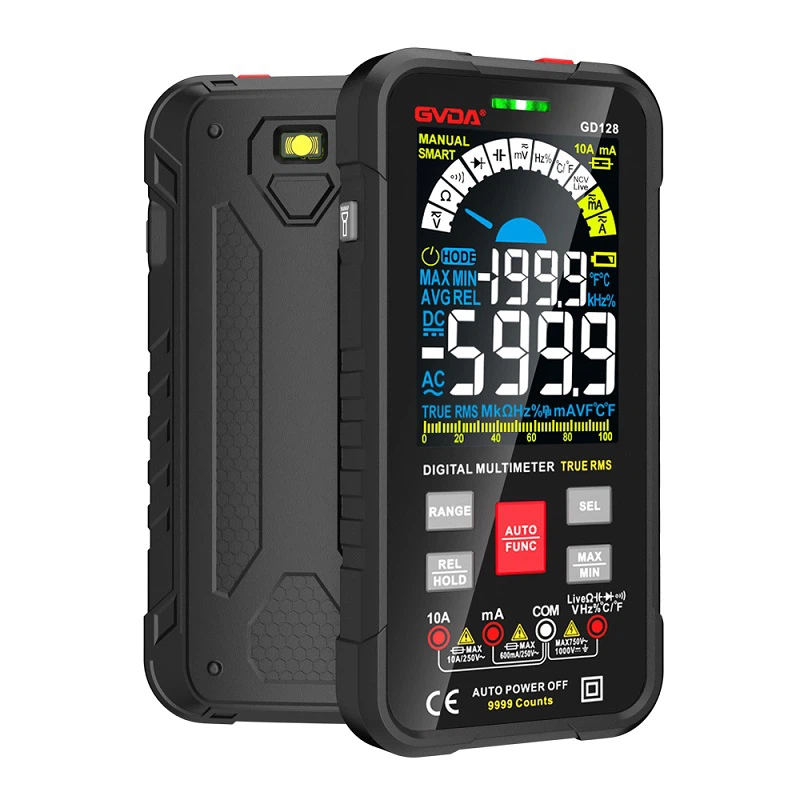
Skills for Judging the Quality of Electronic Components with a Multimeter
A complete circuit board contains a large number of electronic components, and due to many uncertain factors, component damage is a very common occurrence. When equipment malfunctions are mostly caused by damage to components, the detection and maintenance of components become very important. How to judge the quality of a component is a skill that an engineer must learn.
When repairing, it is often necessary to first determine the electrodes of the rectifier bridge pins, which cannot be determined solely by visual inspection and is not safe enough.
Use an electric soldering iron to remove the capacitors, resistors, and rectifier bridges used for voltage reduction
When determining the electrodes of the rectifier bridge pins, we can use a multimeter for assistance. In the R × 1K gear state, touch any pin of the bridge stack with the black pen of the multimeter, and test the other pins with the red pen. If the multimeter displays infinity at this time, it can be determined that the pin touched by the black pen is the output positive pole of the bridge. If the display range is 4K-10K ohms, then the pin touched by the black pen is the negative pole. After determining the positive and negative poles of the red and black pen, the remaining pins are AC inputs.
Using a multimeter to determine the positive and negative poles of a digital tube
Luminescent digital tubes are mainly designed for displaying numbers, but they are widely used. So, how to determine whether the LED is damaged during the maintenance process?
Similarly, a multimeter can still be used for testing here, using the R × 10K and R × 100K gears. First, use a red nose to touch the ground lead end of the digital tube. At this time, use a black pen to measure the other lead ends in sequence. If the test result shows that all segments are emitting light normally, then the digital tube is intact; If one of the segments does not emit light, the digital tube is damaged.
Measurement of nominal resistance of potentiometers
When judging a potentiometer, the nominal resistance value of the potentiometer should be measured first. How to measure the nominal resistance of a potentiometer?
Adjust the resistance gear of the multimeter, using the "2" end as the moving contact. If the pointer or resistance value does not move in the ohm gear, the potentiometer is damaged. Then measure if there are any issues with the contact between the potentiometer arm and the resistor. You can use the "1, 2" or "2, 3" terminals of the multimeter's ohm range to rotate the resistor shaft counterclockwise to the position close to "off", which is the place with the lowest resistance. Then, slowly rotate the shaft in a clockwise direction, and the resistance gradually increases. When the shaft reaches the limit position, the resistance value should be similar to the nominal value of the potentiometer.
The important role of crystal oscillators in circuit boards
Crystal oscillator, also known as crystal oscillator, is an electronic component made of quartz. Crystal oscillator, also known as quartz oscillator, is an important component in clock circuits and serves as a reference frequency provider for computer network cards, graphics cards, and motherboards.
When testing the crystal oscillator, first use a multimeter to measure the resistance value of the crystal oscillator in the R × 10K range. If the detection result is infinite, it indicates that there is no short circuit or leakage phenomenon in the crystal oscillator. After testing the resistance to be normal, insert the test pen into the test socket and pinch any pin with your fingers, while the other pin touches the top metal of the test pen. If the test pen lights up (neon bubbles), the crystal oscillator is intact. On the contrary, the crystal oscillator is damaged.