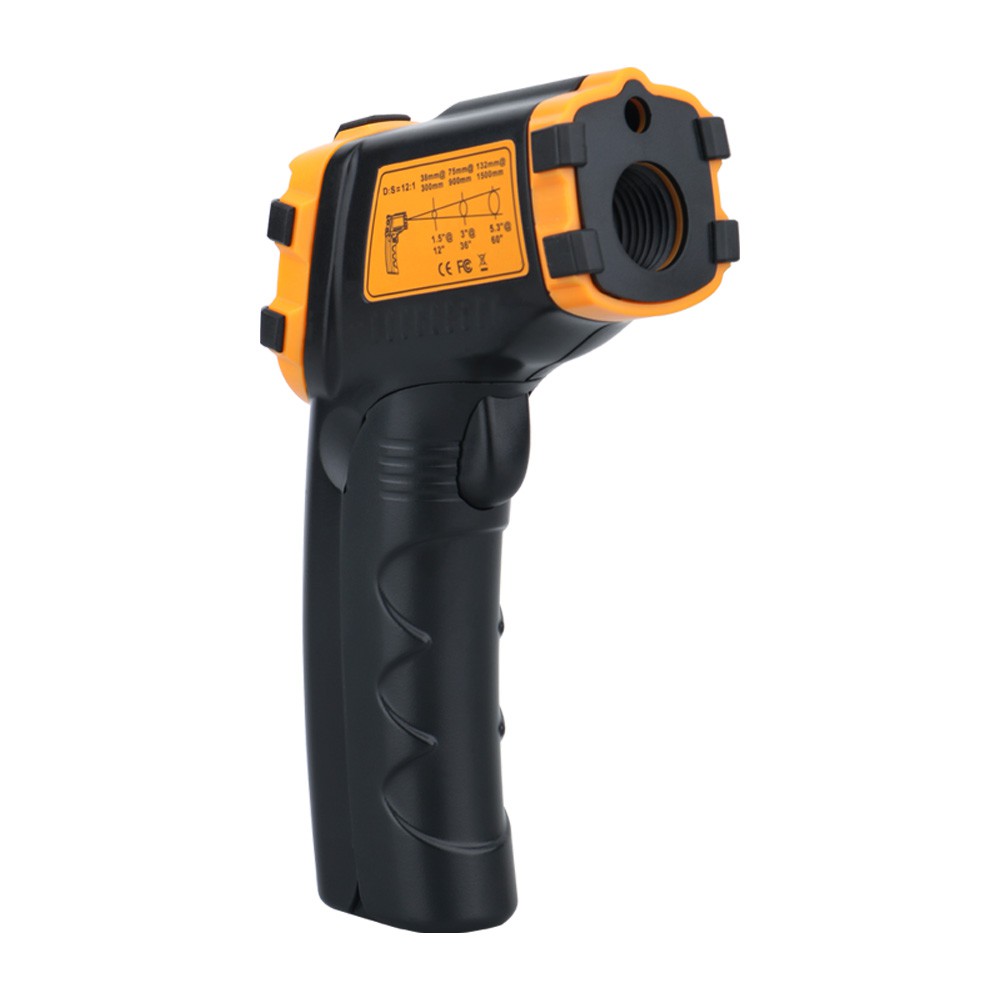
Surface emitting two-coloured infrared thermometer
Any infrared measuring instrument is to measure the infrared radiation power on the surface of the electrical equipment to obtain the temperature information of the equipment. And in the case of infrared diagnostic instruments receive the same infrared radiation power from the target, due to the different emissivity of the surface of the target, will get different detection results. That is to say, for the same radiant power, the lower the emissivity, the higher the temperature will be displayed. The emissivity of the surface of the object is mainly determined by the nature of the material and the state of the surface (such as surface oxidation, coating material, roughness and dirt state, etc.). Therefore, in order to apply infrared thermal imaging instruments to accurately measure the temperature of electrical equipment, it is necessary to know the value of the emissivity of the target inspected, and enter this value into the computer as an important parameter for calculating the temperature or adjust the ε-correction value of the infrared measuring instrument in order to correct the emissivity of the measured temperature output value. Eliminate the impact of emissivity on the detection results of the other two countermeasures are: when using infrared thermography for measurement, the emission to be corrected to find out the emissivity value of the surface of the equipment components being measured emissivity correction, so as to obtain a reliable temperature measurement results to improve the reliability of the detection; for infrared detection of fault-frequent equipment components, in order to make the detection results have a good comparability, you can use the application of appropriate coating Paint method to increase and stabilise the emissivity value, in order to obtain the true temperature of the surface of the equipment being measured.
The slope is the ratio of the emissivity in the monochrome broadband mode to the emissivity in the monochrome narrowband mode, and is used in the two-colour temperature measurement mode to calculate the measured temperature. Since the emissivity in narrowband mode cannot be adjusted, it is found by dividing the monochrome broadband emissivity by the slope value.
If you need to note the narrowband temperature, make the narrowband emissivity greater than 1.00 (or less than 0.10) by adjusting the slope and broadband emissivity.
Emissivity is a measure of an object's ability to radiate infrared light. This value can range from 0 (for mirrors) to 1.0 (for black bodies), and if the emissivity is set to a value greater than the actual emissivity, the sensor head will read low. For example, if the actual emissivity of an object is 0.9 and the set value is 0.95, the measured temperature will be low.
How to Determine Slope
Effective methods of determining the slope include measuring the temperature of the object using a probe (e.g. RTD), thermocouple, or other suitable method. Once the actual temperature is obtained, the emissivity setting is adjusted until the temperature reading from the sensor head is equal to the actual measured temperature, then the correct slope value is obtained.
How to determine the emissivity
1. Determine the actual temperature of the object using a probe (e.g. RTD), thermocouple, or other suitable method. Adjust the value of emissivity until the temperature reading of the sensing head is the same as the actual temperature, i.e., the correct emissivity is obtained.
2. If a part of the surface of the object can be coated, the surface of the object can be blackened with non-glossy carbon black, at which time the emissivity is about 0.98. Set the emissivity to 0.98 and measure the temperature of the blackened part. *Afterwards, measure the area adjacent to the blackened portion of the object and adjust the emissivity until the temperature reading is equal to the actual temperature. The correct emissivity is then obtained.
3. Optimise the measurement of surface temperature according to the following guidelines:
1, Use a measuring instrument to determine the emissivity of the object.
2. Avoid reflections as much as possible; shield the object from high temperature heat sources in the surrounding environment.
3, When the object has a high temperature, if several partially overlapping wavelengths are available, select the shorter wavelength.
4, for translucent materials, such as glass; temperature measurement should ensure that the background temperature is uniform and lower than the object temperature.
5, when the emissivity is less than 0.9, the sensing head and the surface of the target object should be kept as perpendicular as possible. Don't let the angle between the axis of the sensor head and the object surface normal is greater than 45 °!