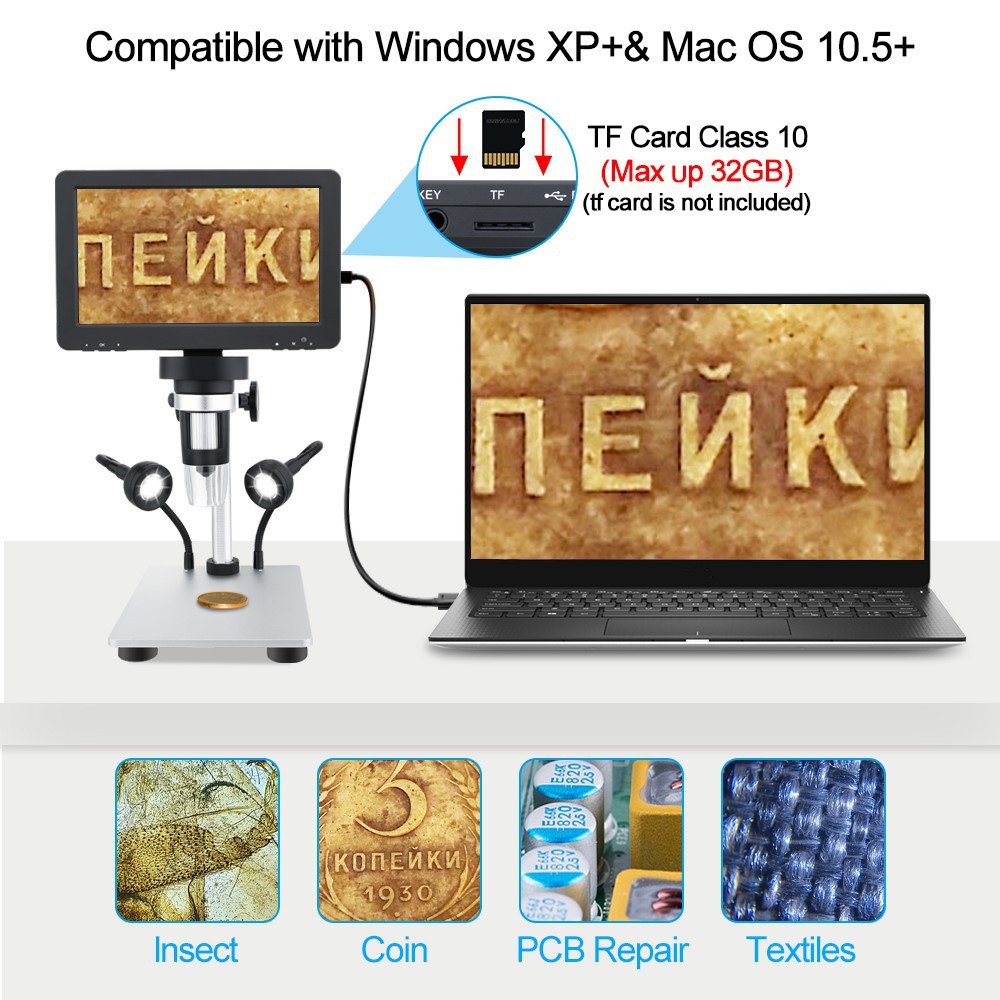
Use of a stereo microscope Environment for using stereomicroscopes
Stereo microscope, also known as "solid microscope" or "dissecting mirror", can produce upright three-dimensional space images when observing objects. It has a strong stereoscopic effect, clear and wide imaging, and has a long working distance, and it is a conventional microscope with a very wide range of applications. The operation is convenient, intuitive, and the verification efficiency is high. It is suitable for the inspection of electronic industry production lines, the verification of printed circuit boards, the verification of soldering defects (printing misalignment, edge collapse, etc.) in printed circuit assemblies, the verification of single-board PCs, and vacuum fluorescence. Display VFD verification, etc., with measurement software can measure various data.
Instructions
(1) After installing the microscope, plug in the power plug, turn on the power switch, and select the lighting mode after ensuring that the power supply voltage is consistent with the rated voltage of the microscope;
(2) According to the specimens to be observed, select the platen (when observing transparent specimens, choose a frosted glass platen; observe opaque specimens, choose a black and white platen), put it into the hole of the base platen, and lock it;
(3) Loosen the fastening screw on the focusing slide seat, adjust the height of the mirror body, visually check that the working distance is about 80mm, (make it roughly the same working distance as the magnification of the selected objective lens) after adjustment, lock it Bracket, close the safety ring to the focusing bracket and lock it;
(4) After installing the eyepiece, first loosen the screw on the eyepiece tube, and then tighten the screw after installing the eyepiece (be careful when putting the eyepiece into the eyepiece tube, do not touch the lens surface of the lens);
(5) Adjust the interpupillary distance. When the user observes a circular field of view through the two eyepieces, the two prism boxes should be moved to change the exit pupil distance of the eyepiece tube so that a circular field of view can be observed. Completely overlapping circular field of view (indicating that the interpupillary distance has been adjusted);
(6) Observing the specimen (focusing on the specimen). First adjust the dioptric ring on the left eyepiece tube to the position of the 0 reticle. Normally, first observe from the right eyepiece tube (that is, the fixed eyepiece tube), turn the zoom tube (for models with a zoom device) to the highest magnification position, and turn the focusing handwheel to focus on the specimen until the specimen's After the image is clear, turn the zoom tube to the lowest magnification position. At this time, use the left eyepiece tube to observe. If it is not clear, adjust the diopter ring on the eyepiece tube along the axial direction until the image of the specimen is clear, and then binocular Observe its focusing effect;
(7) When the observation is finished, turn off the power, remove the specimen, and cover the microscope tightly with a dust cover.
use environment
(1) The instrument should avoid direct sunlight, high temperature, humidity, dust and corrosion of acid and alkali gases;
(2) The workshop should always be kept clean, and the instrument should be covered with a dust cover after use;
(3) The microscope should be placed on a firm and stable workbench;
(4) Avoid dirt or fingers from staining the lens and color filter during operation.