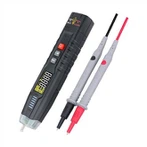
1. To determine whether the object is charged or not. Its internal structure is a light bulb with only two electrodes. The bulb is filled with neon gas, commonly known as neon bulb. One pole of it is connected to the tip of the pen, and the other pole is connected to the other end of the pen with a high resistance in series. When the voltage between the two poles of the neon bulb reaches a certain value, a glow is generated between the two poles, and the intensity of the glow is proportional to the voltage between the two poles. When the voltage of the charged body to the ground is greater than the glow voltage of the neon bulb, and the tip of the test pen touches it, the other end is grounded through the human body, so the test pen will emit light. The function of the resistance in the test pen is to limit the current flowing through the human body to avoid danger.
2. It can be used for low-voltage nuclear phase measurement to measure whether any wires in the line are in phase or out of phase. The specific method is: stand on an object insulated from the earth, hold a measuring pen in both hands, and then test on the two wires to be tested. If the two measuring pens glow brightly, the two wires are Out-of-phase; on the contrary, it is in-phase, which is judged by the principle that the voltage difference between the two poles of the neon bulb in the test pen is proportional to its luminous intensity.
3. It can be used to distinguish between alternating current and direct current. When testing with a test pen, if both poles in the gas bubble of the test pen glow, it is alternating current; if only one of the two poles glows, it is direct current.
4. It can judge the positive and negative poles of direct current. Connect the test pen to the DC circuit to test, the neon bulb that glows is the positive pole, and the non-lighting pole is the negative pole.
5. It can be used to judge whether the DC is grounded. In the DC system insulated to the ground, you can stand on the ground and use the test pen to contact the positive or negative pole in the DC system. If the neon bulb of the test pen does not light up, there is no grounding phenomenon. If the neon bulb glows, it means there is a grounding phenomenon, and if it glows at the tip of the pen, it means that the positive electrode is grounded. If it shines on the finger end, it is the negative ground. However, it must be pointed out that in a DC system with a grounding monitoring relay, this method cannot be used to determine whether the DC system is grounded.