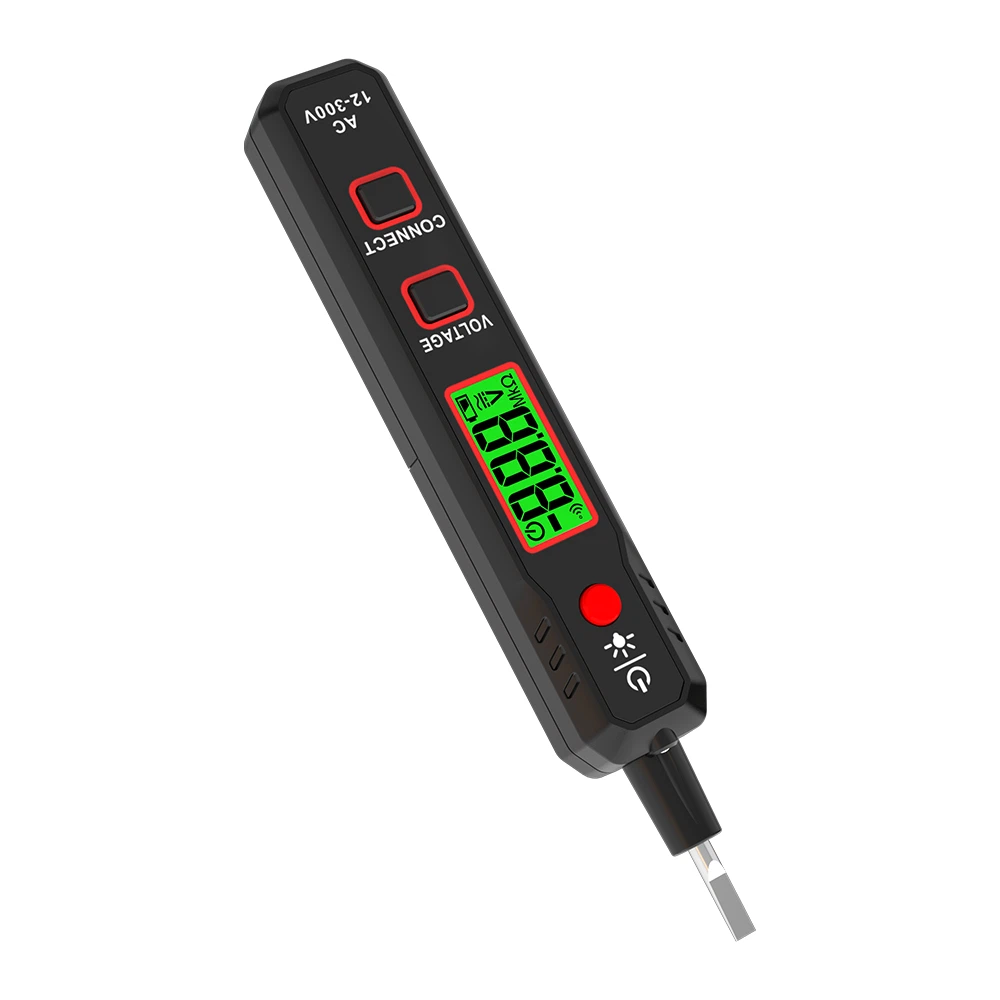
When using a test pen to test the switch controlled live wire, why does the zero line light up slightly?
Firstly, it should be clarified that regardless of whether the live wire (professionally referred to as the phase wire) is disconnected or not, the neutral wire is not normally charged. If the neutral line is charged, it indicates that there is a problem in some part of the line. So how can we identify where the problem lies? For ordinary electricity customers, share some simple and practical quick search and processing methods:
1, Regarding this issue description, the reason for this phenomenon is usually due to oxidation at the overlap of the zero wire, resulting in poor contact. However, this situation can be ruled out as a problem of main line zero wire breakage, as the fault phenomenon and consequences caused by main line zero wire breakage or poor contact are different. We will not analyze it here.
2, Step by step search and narrow down the range. First, check whether the zero line on the upper and lower pile heads of the switch is normal when the main switch is in the closed position. If the zero line is normal and there is no electricity, it is generally a problem in the back section of the switch. You can check the joints on the circuit section by section, find the fault point, and then rewire and wrap it. Because the problem usually occurs at the line connection. The most common occurrence of this situation is usually the old and outdated power lines from a long time ago. Nowadays, indoor wiring and installation are very scientific, and this problem usually does not occur.
3, If there is no power on the zero line at the top of the switch when checking the up and down piles, and there is power on the down pile, this situation is usually due to the switch being broken. You can open and close the switch several times, and sometimes it can temporarily restore power, but it is still necessary to replace the switch in a timely manner.
If the zero line on the switch pile head is also live during inspection, this situation can generally only be reported by calling for repair, as there may be pole climbing inspection, which users cannot easily solve.
There are two possibilities. Firstly, some wall switches have an indicator light connected across the switch to allow users to easily find the switch position in the dark. When the switch is turned off, there is still a small current flowing through the indicator light. Secondly, all fluorescent lamps, whether ordinary fluorescent tubes or energy-saving lamps, have a certain delayed extinction characteristic of their fluorescent powder, called "afterglow". Now that science has advanced, with LCD displays and corresponding display circuits, it is easy to display non simultaneous events on the same screen. For example, an electrocardiogram monitor displays a horizontal line that fluctuates up and down with the beating of the heart. However, in reality, all fluctuations on this horizontal line do not occur at the same time, but have a time process. In the past, in the era of only CRT displays, there was only one point that fluctuated with the heartbeat. In order to display a line, a "long afterglow" display had to be used, so that the scanning point did not immediately go out after passing through, but gradually went out after a long period of time, making the movement of a point become a display of a line. The oscilloscope at that time also had the same principle.
The zero line is the circuit of all electrical equipment. Due to the presence of a certain resistance in the zero line, the higher the resistance or current of the zero line, the higher the corresponding voltage on it. So the zero line is not completely without voltage, and it is also possible for the measuring pen to be slightly bright. Of course, if there is poor contact in the zero line circuit, it will cause the zero line voltage to be higher. So it's best to measure the voltage with a voltmeter.
A broken fuse in one phase of the transformer can also cause the zero line to light up slightly when measured with an electric pen. When a motor is burned out and a phase is grounded far away from the line, it can also cause the zero line to light up slightly when measured with an electric pen. When the power supply is disconnected from the zero line, it can also be measured through electrical appliances that the zero line has an electric pen that is relatively bright.
It's very simple, as long as the zero line circuit is well conductive, this phenomenon cannot occur. If this phenomenon occurs, it is certain that there is a disconnection or poor conductivity in some part of the zero line circuit, or that the electrical appliances are connected in series. The solution is to disconnect the zero line circuit or firmly connect the parts with poor conductivity. If two electrical appliances are connected in series in one circuit, cut off one electrical appliance and only retain one.