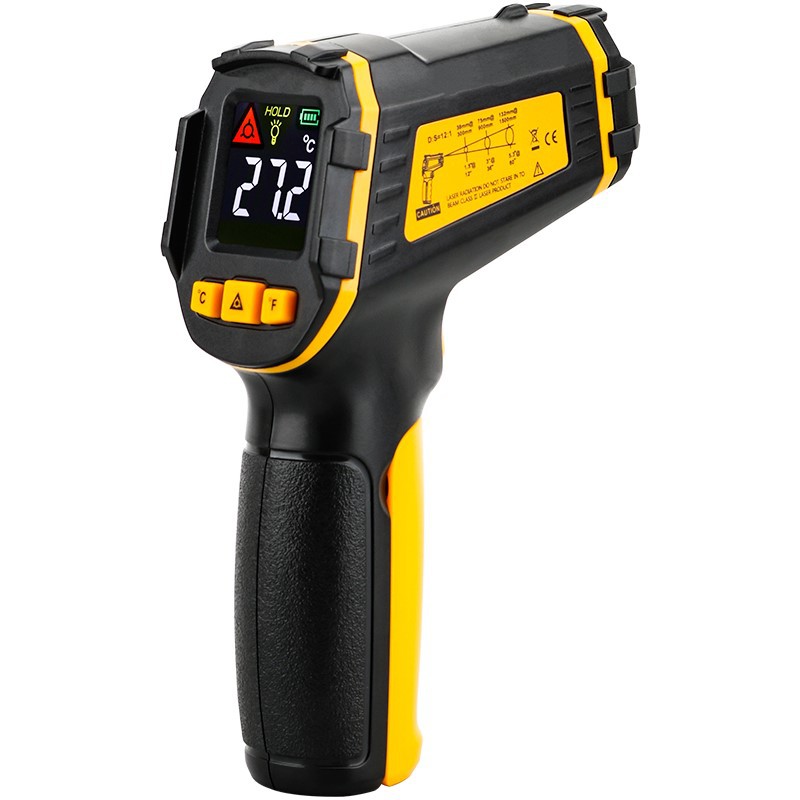
How to Improve the Measurement Accuracy of Infrared Thermometers
1. Characteristics of Infrared Thermometers
Infrared temperature measurement is a non-contact temperature sensing technology with the following features:(1) Non-contact measurement;(2) Fast response time, within tenths of a second;(3) High sensitivity, with a temperature resolution of 0.1℃ and millimeter-level spatial resolution;(4) Wide temperature measurement range, from dozens of degrees below zero to over 1,000℃.
Since no physical contact with the measured object is required, it can safely detect the temperature of inaccessible objects without causing contamination or damage to the measured surface. Portable infrared thermometers feature easy portability and simple operation, supporting temperature detection for various targets. They are widely applied in equipment fault diagnosis, HVAC systems, railways, petroleum, chemical engineering, metallurgy, glass processing, metalworking and other industries. Based on the basic principles of infrared temperature measurement, this paper focuses on methods to improve the measurement accuracy of infrared thermometers.
2. Basic Principles of Infrared Temperature Measurement
Infrared ray is a type of invisible light with prominent thermal effects. All objects in nature radiate infrared energy as long as their temperature is higher than absolute zero (-273℃). Infrared temperature measurement calculates an object's temperature by detecting its infrared radiation.
The technology is fundamentally based on the Stefan–Boltzmann Law, which defines the correlation between an object's temperature and radiant energy.Where:E - Radiation power of the object (W/m²);ε - Emissivity of the material;σ - Stefan–Boltzmann constant (5.67×10⁻⁸ W/(m2⋅K4));T - Absolute temperature of the object (K).
It can be concluded from the formula that the object's temperature can be calculated by measuring its radiant power via a detector and obtaining its emissivity through inquiry tables or experimental tests.
3. Methods to Improve the Accuracy of Infrared Thermometers
Confirm the Temperature Measurement Range
The temperature range is one of the most critical performance indicators. For example, Raytek products cover a range from -50℃ to 3000℃, which cannot be achieved by a single model. Each thermometer model is designed for a specific temperature span.
Users shall have a general understanding of the measured temperature to select the appropriate model. The selected range must be fully and accurately determined, neither too narrow nor excessively broad. A narrower measuring range delivers higher resolution of output signals and better precision for more accurate readings. An overlarge range will reduce measurement accuracy and increase errors.