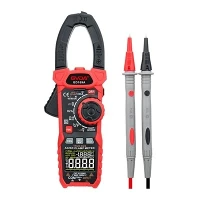
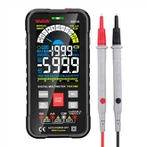
Operating Instructions for Analog & Digital Multimeters
An analog multimeter is an average-responding meter that provides intuitive, visual readings. (Readings are closely related to the deflection angle of the pointer, making them highly intuitive.)
A digital multimeter is an instant sampling meter. It samples and displays measurement results every 0.3 seconds. Sometimes consecutive samples are very close but not identical, which makes reading less convenient than with an analog type.
Analog multimeters generally have no internal amplifiers, resulting in relatively low input resistance. For example, the MF-10 model has a DC voltage sensitivity of 100 kΩ/V, while the MF-500 model has a DC voltage sensitivity of 20 kΩ/V.
Thanks to internal op-amp circuits, digital multimeters can achieve very high input resistance, typically 1 MΩ or higher (enabling higher sensitivity). This minimizes interference with the circuit under test and ensures higher measurement accuracy.
Due to their lower input resistance and discrete-component shunt and voltage-divider circuits, analog multimeters have uneven frequency characteristics (compared to digital types). However, analog meters generally offer better frequency response.
Analog multimeters feature a simple internal structure, resulting in lower cost, fewer functions, easy maintenance, and strong overcurrent / overvoltage withstand capability. Digital multimeters incorporate various circuits for oscillation, amplification, frequency division and protection, offering more functions such as measuring temperature, frequency (within a low range), capacitance, inductance, and acting as a signal generator.
Because digital multimeters rely heavily on integrated circuits, they have weaker overload tolerance. (Although some modern models feature auto-ranging and automatic protection, they are more complex to operate.) They are also generally difficult to repair once damaged.
Digital multimeters produce a low output voltage (usually no more than 1 volt), which is inconvenient for testing components with special voltage characteristics, such as silicon-controlled rectifiers (SCRs) and light-emitting diodes (LEDs).
Analog multimeters deliver a higher output voltage (10.5 V, 12 V, etc.) and larger current (the MF-500, for instance, can output around 100 mA in the ×1 Ω range), making them ideal for testing SCRs, LEDs and similar components.
Beginners are recommended to use analog multimeters, while more experienced users should use both types.