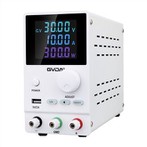
The switching power supply is a relatively new type of power supply.
It has the advantages of high efficiency, light weight, adjustable voltage, and high output power. However, due to the circuit operating in a switch state, the noise is relatively high. Through the following diagram, let's briefly explain the working principle of a step-down switching power supply. As shown in the figure, the circuit consists of switch K (in actual circuits, it is a transistor or field-effect transistor), freewheeling diode D, energy storage inductor L, filtering capacitor C, etc. When the switch is closed, the power supply supplies power to the load through switch K and inductor L, and stores some of the electrical energy in inductor L and capacitor C. Due to the self inductance of inductor L, the current increases relatively slowly after the switch is turned on, meaning that the output cannot immediately reach the power supply voltage value. After a certain period of time, the switch is turned off, and due to the self inductance effect of inductor L (which can be vividly regarded as the inertia effect of the current in the inductor), the current in the circuit will remain unchanged, that is, continue to flow from left to right. This current flows through the load, returns from the ground, flows to the positive terminal of the freewheeling diode D, passes through the diode D, and returns to the left end of the inductor L, thus forming a circuit. By controlling the closing and opening time of the switch (i.e. PWM - Pulse Width Modulation), the output voltage can be controlled. If the on/off time is controlled by detecting the output voltage to maintain the output voltage constant, the purpose of voltage stabilization is achieved.
During the closure of the switch, the inductor stores energy; During the disconnection of the switch, the inductor releases energy, so inductor L is called an energy storage inductor. During the period when the switch is turned off, diode D is responsible for providing a current path to inductor L, so diode D is called a freewheeling diode.
In practical switching power supplies, switch K is replaced by a transistor or field-effect transistor. When the switch is turned off, the current is very small; When the switch is closed, the voltage is very low, so the heating power U× I will be very small. This is the reason for the high efficiency of switch mode power supplies.