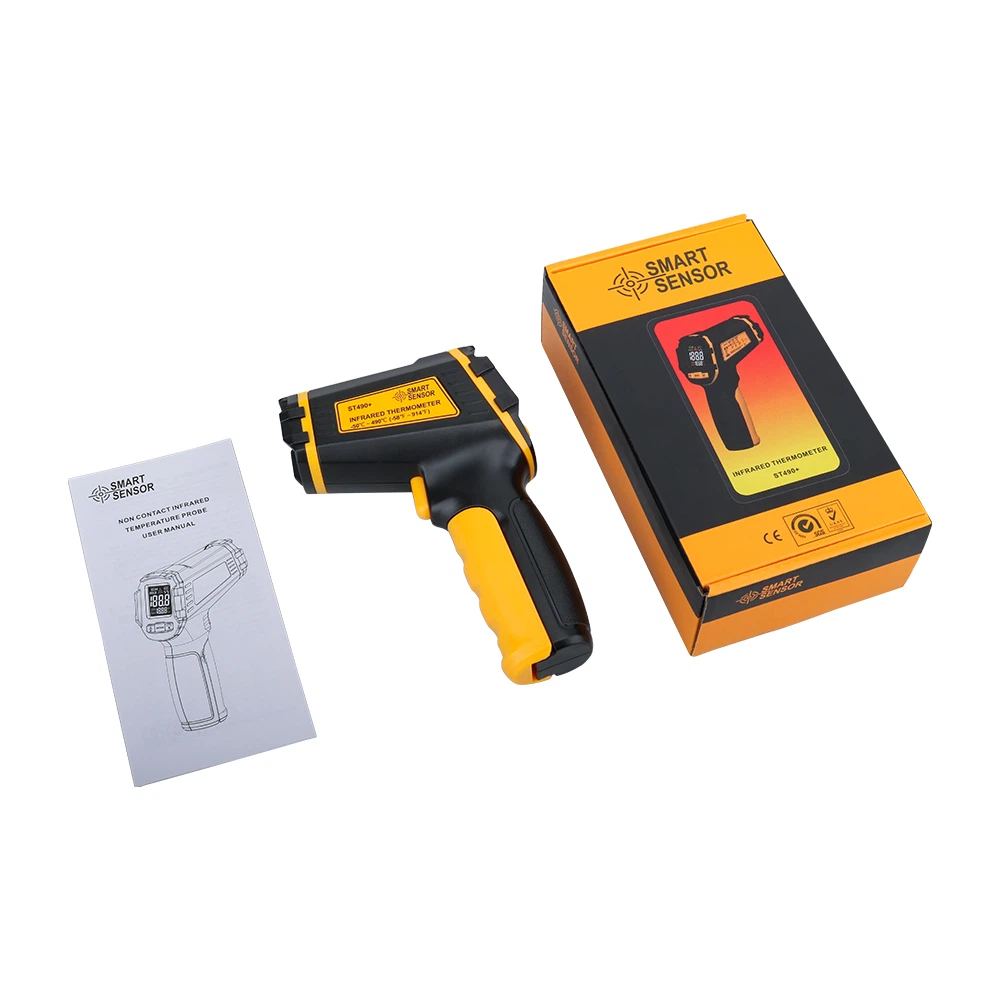
Understanding of high-speed infrared thermometer operation
High-speed infrared thermometer consists of optical system, photoelectric detector, signal amplifier and signal processing, display output and other components. High-speed infrared thermometer is through the infrared detector (thermal detector and photoelectric detector) will be infrared radiation energy measured and converted into electrical signals, and then converted to temperature according to the basic law of radiation.
The optical system collects the target infrared radiation energy within its field of view, the size of which is determined by the optical components of the pyrometer and its position. The infrared energy is focussed on the photodetector and converted into a corresponding electrical signal. This signal is converted into a temperature value for the target by an amplifier and signal processing circuitry, calculated according to an algorithm within the instrument and corrected for target emissivity. In addition, the environmental conditions of the target and the pyrometer, such as temperature, atmosphere, pollution and interference, etc., should also be taken into account on the impact of performance indicators and correction methods.
High-speed infrared thermometers are used to measure the temperature of an object's surface. The energy emitted, reflected and transmitted by the thermometer's optics converges on a detector, and the thermometer's electronics convert this information into a temperature reading that is displayed on the thermometer's display panel. The temperature displayed by the pyrometer is often referred to as the brightness temperature of the target, which differs from the real temperature of the object because the emissivity of the object has an effect on the radiant temperature, and almost all real objects that exist in nature are not black bodies. The radiation of all real objects in addition to relying on the wavelength of the radiation and the temperature of the object, but also with the type of material that constitutes the object, the preparation method, the thermal process, as well as the surface state and environmental conditions and other factors. Therefore, in order for the blackbody radiation law to apply to all real objects, a proportionality coefficient, i.e., the emissivity, related to the nature of the material and the state of the surface, must be introduced. This coefficient indicates how close the thermal radiation of the actual object is to the blackbody radiation, and its value is between 0 and 1. According to the law of radiation, as soon as the emissivity of a material is known, the infrared radiation properties of any object are known